Discover efficient, quiet, and safer baseboard heating options for contemporary rooms. This guide highlights five top picks, focusing on safety features, energy efficiency, and easy installation. Each product is evaluated on heat output, thermostat control, and durability to help homeowners choose a model that fits standard American living spaces.
| Product | Brand | Key Heat (W) | Voltage | Notes |
|---|---|---|---|---|
| Cadet F Series 48″ Electric Baseboard Heater | Cadet | 1000/750 | 240/208 | High power for small to medium rooms |
| Air Choice 33” Baseboard Heater | Air Choice | 1500 | Unknown | Fanless design with remote control |
| EZ-HEAT 1,500W Baseboard Heater | EZ-HEAT | 1500 | Unknown | Adjustable thermostat, stay-cool body |
| Comfort Zone 1,500W Baseboard | Comfort Zone | 1500 | Unknown | Two heat settings, overheat protection |
| BEYOND HEAT 1,500W Baseboard | BEYOND HEAT | 1500 | Unknown | Quiet operation, adjustable thermostat |
Cadet F Series 48″ Electric Baseboard Heater
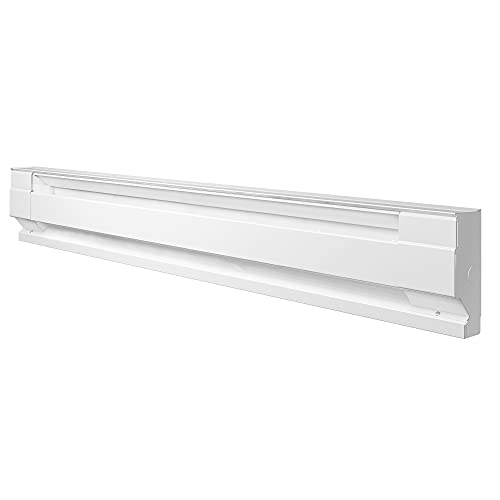
The Cadet F Series 48″ baseboard heater offers flexible installation with universal wiring and pre-punched knockouts at 1-inch intervals for easy floor or wall mounting. It operates at 1000/750 Watts with 240/208 Volt options, delivering robust heat for small to medium rooms. Safety features include a high-temperature shutoff to reduce risk, and its steel construction provides durability for long-term use. This model is suitable for retrofit projects where discreet, low-profile heating is required, blending into existing decor while maintaining steady warmth.
Air Choice 33” Baseboard Heater

The Air Choice 33” baseboard heater provides a fanless, quiet heating solution for large rooms up to about 270 square feet. It includes a top air outlet designed to distribute warmth efficiently, though the top surface may become warm to the touch, so keep direct contact minimal. With a remote and thermostat, two heat modes (low and high) help tailor comfort levels. It’s best placed on hard surfaces to avoid heat transfer to wooden floors or carpets, and its compact footprint fits tighter spaces.
EZ-HEAT 1,500W Baseboard Heater

EZ-HEAT’s CZ600 model provides 1500 Watts of convection heating with an adjustable thermostat and two heat settings. It features a dent-proof end panel design, a stay-cool outer surface, and an overheat protection sensor for safety. The included tip-over switch adds another safety layer, making it a practical option for bedrooms, offices, and living spaces where quiet operation is valued. The unit’s design prioritizes safety and user-friendly controls for easy temperature management.
Comfort Zone Electric Baseboard Heater

The Comfort Zone 1,500W model mirrors the CZ600 line with two heat settings and a programmable thermostat to adapt to different times of day. It emphasizes safety with a tip-over switch and overheat protection, and a stay-cool surface to minimize incidental burns. Its quiet operation makes it suitable for bedrooms and offices where ambient noise should stay low while maintaining a comfortable temperature.
Cadet F Series 72″ Electric Baseboard Heater

The Cadet 72″ baseboard heater offers a high-length footprint designed to heat larger zones, with 1500/1125 Watt capability and a 240/208 Volt configuration. Constructed from durable 25-gauge steel with a powder-coated finish, this model supports thermostat integration for precise temperature control. It is well-suited for longer wall spaces, basements, or living areas that require consistent warmth across a wider area. Installation typically relies on compatible thermostats and proper mounting practices.
Buying Guide: Key Purchase Considerations
- Room size and heat output: Match wattage to room square footage. Larger rooms generally require higher wattage units (1200–1500W+) with robust thermostat control.
- Thermostat and controls: Look for models with adjustable thermostats and programmable features to optimize energy use and comfort across different times of day.
- Safety features: Prioritize tip-over switches, overheat protection, stay-cool casings, and safe clearance from furniture and drapes.
- Noise and air flow: Fanless models minimize noise but may heat more slowly; consider your tolerance for subtle sound vs. faster warm-up needs.
- Installation: Check mounting options (wall vs. floor), wiring requirements, and whether pre-punched knockouts or thermostat compatibility are needed for your setup.
- Durability and finish: Powder-coated steel and dent-proof end panels increase longevity in high-traffic spaces.
- Maintenance: Baseboard heaters typically require little maintenance; ensure easy access for cleaning and occasional checks.
- Energy efficiency: Units with good thermal efficiency and programmable features can reduce energy consumption over time.