When choosing a horizontal venting garage heater, you want reliable warmth without complex installation hurdles. The right model delivers strong BTU output, safe venting for vertical or horizontal configurations, and straightforward maintenance. Below are five top options that fit the “horizontal venting” criterion and are well-suited for American garages, workshops, and light industrial spaces. Each product is evaluated on performance, venting versatility, and practical features to help you compare at a glance.
Summary of Selected Products
| Product | Brand | BTU / Area | Venting |
|---|---|---|---|
| Mr. Heater F260550 Big Maxx MHU50NG | Mr. Heater | 50,000 BTU / up to 1,250 sq. ft. | Vertical or horizontal venting |
| Mr. Heater F260560 Big Maxx MHU80NG | Mr. Heater | 80,000 BTU / up to 2,000 sq. ft. | Vertical or horizontal venting |
| Reznor UDXC-150 | 1HVAC | 150,000 BTU | Ceiling mount or wall mount; horizontal venting kit options |
| Reznor UDXC-150 LP | 1HVAC | 150,000 BTU | Ceiling or wall mount; horizontal venting kit options |
| Heat Storm HS-6000-GC | Heat Storm | 3,000–6,000 W (equivalent to 10,000–20,000 BTU) | Ceiling or wall mounted |
Mr. Heater Big Maxx MHU50NG (50,000 BTU)
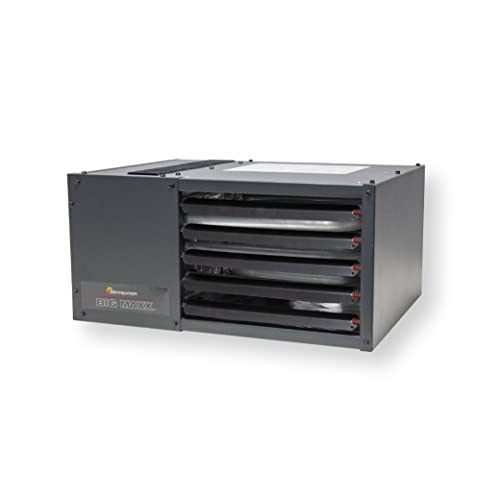
The 50,000 BTU model is designed for spaces up to roughly 1,250 square feet. It features a powered exhaust system that supports both vertical and horizontal venting, enabling flexible installation alongside existing vent runs. Access to the thermostat and gas connection from the exterior simplifies service. This unit emphasizes a compact footprint without compromising warmth, making it a practical choice for mid-size garages seeking even heat distribution.
Mr. Heater Big Maxx MHU80NG (80,000 BTU)
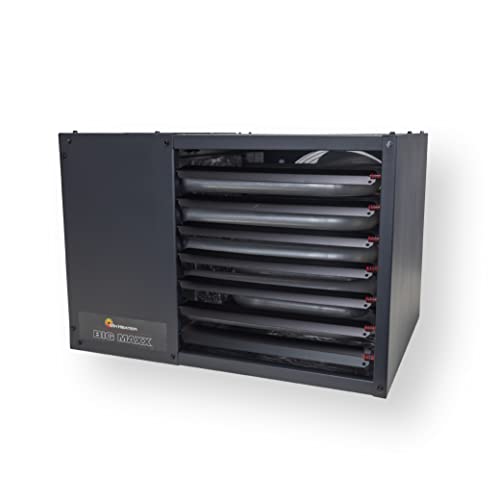
This larger unit delivers up to 80,000 BTU to heat spaces around 2,000 square feet. It is marketed with a larger footprint and includes configurable venting for horizontal or vertical exhausts. The packaging notes that a thermostat, hose, and regulator are not included, which keeps initial costs flexible but requires planning for compatibility with your propane/natural gas setup. The unit’s robust design makes it suitable for spaces with higher heating demands.
Reznor UDXC-150 Natural Gas

Reznor’s UDXC-150 is a 150,000 BTU unit designed for industrial or commercial garages and shops. It supports ceiling mounting and can be paired with a horizontal B-vent kit for flexible vent routing. The heater emphasizes high thermal efficiency and provides a reliable heat output for larger spaces. It is positioned as a ceiling-mounted option with versatility for mounting and venting once brackets are selected.
Reznor UDXC-150 LP Propane
This propane-fueled counterpart of the UDXC-150 also delivers 150,000 BTU and uses a ceiling or wall-mount approach with optional horizontal venting components. It’s optimized for spaces that prefer propane energy sources, with the same emphasis on efficiency and robust production capacity. As with the natural gas version, mounting and venting accessories are sold separately, allowing a customized installation plan.
DuraVent Horizontal Vent Unit Kit

This horizontal vent unit kit is designed to accompany compatible heaters for side-mounted venting configurations. It’s a practical accessory for ensure proper venting alignment in tight spaces where horizontal routing is a priority. The kit’s compatibility with multiple item numbers suggests broad applicability across different heater models.
Heat Storm HS-6000-GC

The Heat Storm HS-6000-GC provides instant heating with a 3,000 to 6,000-watt range, translating to roughly 10,000 to 20,000 BTU. It’s designed for versatile deployment in smaller garages or workshop areas, with ceiling or wall mounting options and Wi-Fi control. This model serves as a compact, modern alternative when a full-size gas heater isn’t required or feasible, offering convenient zone heating with digital convenience features.
Buying Guide: Key Considerations for Horizontal Venting Garage Heaters
Choosing a horizontal venting heater requires evaluating space size, venting flexibility, fuel type, and installation complexity. Consider the following perspectives to determine the best fit for your garage or workshop:
- Heat output vs. space area: Larger garages benefit from high-BTU units (e.g., 150,000 BTU or higher) for rapid, even warming; smaller spaces can rely on 50,000–80,000 BTU models for sustained comfort.
- Venting configuration: Verify whether the heater supports horizontal venting and how it integrates with existing exhaust runs. Some units offer flexible options with external access for maintenance, which can simplify installation.
- Fuel source and energy efficiency: Natural gas and propane units tend to run efficiently for long-term use in garages. Propane models require proper fuel storage and regulators; natural gas needs a reliable gas line.
- Installation considerations: Ceiling-mounted vs. wall-mounted setups impact room clearance and safety. Check required clearances from floor and walls, plus any mounting brackets or venting kits sold separately.
- Maintenance and safety features: Look for built-in thermostats, accessible service panels, and safety shutoffs. Powered exhaust and sealed combustion improve air quality and efficiency.
- Electrical requirements: For electric units, ensure your circuit capacity supports the wattage and that hardwired installation complies with local codes.
- Noise and comfort: Some models with high airflow can produce more operating noise. Evaluate fan speed, quiet modes, and heat distribution patterns for your workspace needs.
- Future-proofing: If you anticipate changes in space usage or expansion, consider a scalable system with adaptable venting options and compatible accessories.
When selecting among the options above, compare the BTU rating, venting compatibility, and mounting flexibility to ensure the heater matches your garage size and ventilation constraints. Always follow installation instructions and local code requirements, and consult a professional if uncertain about venting and gas connections.