Basement spaces can stay damp and chilly, making a reliable portable heater essential. This guide highlights five top options that balance heat output, safety, and smart features to keep basements comfortable. Each selection is geared toward medium-to-large areas, with safety protections and energy-efficient modes to help manage heating costs.
| Product | Brand | Key Feature | Power |
|---|---|---|---|
| Dr Infrared Heater Portable Space Heater | DR. INFRARED HEATER | Infrared quartz plus PTC, large-room capable | 1500W |
| FLANUR Space Heaters for Indoor Use | FLANUR | WiFi/app control, 4 modes, 2.4GHz, 70° oscillation | 1500W |
| Dreo Space Heater Indoor (Large Room) | Dreo | Quiet 25dB, 70° oscillation, multiple safety protections | 1500W |
| Dreo Space Heater (Thermostat & Remote) | Dreo | Smart thermostat, 5 modes, fast heat | 1500W |
| WINHL Small Portable Heater | WINHL | Wide-angle oscillation, remote control | 1500W |
Note: The selections above focus on 1500W ceramic or infrared models with safety features suitable for basement use, including tip-over and overheat protection, along with user-friendly controls and in some cases smart connectivity for remote management.
Dr Infrared Heater Portable Space Heater
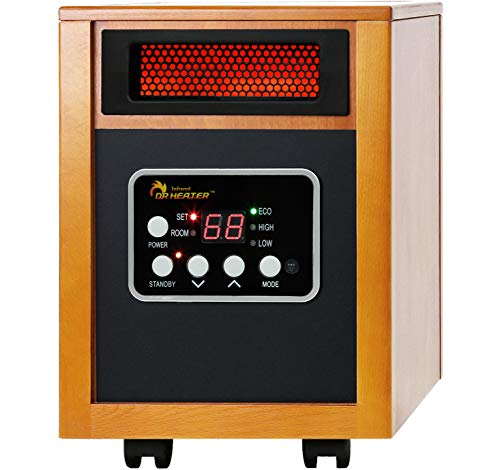
The Dr Infrared Heater delivers heat through a dual system combining infrared quartz tubes with PTC technology, designed to warm larger basements efficiently. It features Auto Energy Saving Mode, plus high/low settings and a 12-hour automatic shut-off timer. Safety is addressed with tip-over and overheat protection, while the built-in remote control makes adjustments convenient from across the room. A quiet blower operates at around 39 dB, making it suitable for a basement space that doubles as a living area or workspace. With 5200 BTU output, this unit aims to distribute warmth across a sizable footprint, which can help maintain comfort in cooler basement corners.
FLANUR Space Heaters For Indoor Use

The FLANUR heater emphasizes smart connectivity and convenience, featuring WiFi control via the Havaworks app and compatibility with Alexa and Google Home. It offers a 12-hour timer and four operation modes (1500W, 1000W, ECO, fan only), plus a 70-degree oscillation to spread warmth. The unit is built with flame-retardant materials and includes safety features such as overheat and tip-over protection, a 24-hour auto-off option, and dual fuse protection. A child lock enhances safety for households with kids. In ECO mode, the heater automatically reduces output to conserve energy while delivering steady warmth.
Dreo Space Heater Indoor (Large Room)

The Dreo large-room heater combines a high-velocity airflow design with quiet operation (as low as 25dB). The 25-inch form factor and extended heat reach help distribute warmth across bigger basements. Safety features include V0 flame-retardant casing, reinforced plug, 45° tip-over protection, and ETL certification. A child lock adds further protection, and the unit is designed to keep noise at a minimum for comfort during work or sleep. The model emphasizes efficient heat delivery for larger spaces without overwhelming the room with sound or heat in one spot.
Dreo Space Heater, Thermostat & Remote

This Dreo model focuses on thermostat-based control and smart energy management. It uses Hyperamics 1500W PTC heating with a redesigned heat funnel to accelerate warmth and extend reach. Safety includes tilt-detection for improved tip-over protection, V0 flame retardant materials, and an ETL-certified plug. The enhanced NTC chipset enables precise temperature control with a broad 41-95°F range and fine increments, allowing basements to maintain a steady and comfortable temperature with energy savings in mind. Quiet operation and reliable protection make it suitable for bedrooms or living areas in basements.
Dreo Space Heater With Thermostat & Remote

This 2025-upgraded Dreo model emphasizes a smart heating experience with a digital display, 12-hour timer, and five modes. The unit leverages Hyperamics 1500W PTC technology and a new heat funnel design to boost heat delivery and circulation up to 200% farther than traditional heaters. Safety features include tilt detection, V0 flame-retardant materials, a robust safety plug, and ETL certification. The thermostat integration allows precise adjustments (41-95°F with small increments) to balance comfort and energy use, making it a dependable option for larger basement spaces or home offices.
WINHL Small Portable Heater

The WINHL heater focuses on efficiency in compact spaces, delivering rapid heat via PTC ceramic technology. It features wide-angle auto-oscillation to spread warmth across more of a basement, plus a remote control for convenient operation. While compact, the unit maintains essential safety features such as overheat protection and tip-over safeguards. The combination of fast heating and broad distribution makes it suitable for smaller basement zones or as a supplementary heat source in larger spaces.
Buying Guide: Key Purchase Considerations
- Room size and heat output: For basements, choose a heater with strong BTU output or 1500W power and a design that can distribute heat across a larger square footage.
- Safety features: Tip-over and overheat protection are essential. Look for ETL certification, flame-retardant housing, and a sturdy plug to minimize risk in damp or humid environments.
- Heat type: Infrared and ceramic heaters offer different warmth profiles. Infrared tends to heat objects and people directly, while ceramic models warm the air and circulate it with a fan. In basements, a heater with consistent air distribution often feels more comfortable.
- Thermostat and timers: A programmable thermostat and 12–24 hour timer help manage energy use in spaces that may be unused for long periods.
- Noise level: If the basement doubles as a living or working space, consider models designed for quiet operation (below 35 dB is ideal for bedrooms, around 25–34 dB for living spaces).
- Smart features: WiFi, voice control, and app-based scheduling add convenience, especially for basements that aren’t always readily accessible.
- Power source and wiring: Ensure your electrical circuit can safely support a 1500W unit, and avoid using extension cords in general.
- Portability: If you need heat in multiple basement zones, select a compact, light unit with easy maneuverability.