Choosing a powerful heater capable of delivering steady warmth in garages, construction sites, outdoor workspaces, and large rooms requires understanding BTU ranges, fuel types, safety features, and operating efficiency. This guide highlights top performers with high BTU output to help you compare options and select a model that meets demanding heating needs.
| Product | Brand | BTU Range | Fuel Type |
|---|---|---|---|
| Mr. Heater MH170QFAVT | Mr. Heater | 125,000–170,000 | Propane |
| Mr. Heater F271390 | Mr. Heater | 125,000 | Propane |
| Dura Heat GFA150A | Dura Heat | 120,000–150,000 | Propane |
| Dura Heat DFA135C | Dura Heat | 135,000 | Propane |
| Dura Heat LPC80 | Dura Heat | 50,000–80,000 | Propane |
Note: All models listed operate on propane and are designed for heavy use in challenging environments. The selection emphasizes high BTU output, safety features, and durability to support extended heating in large spaces.
Mr. Heater MH170QFAVT 170,000 BTU Portable Heater

The Mr. Heater MH170QFAVT delivers 125,000 to 170,000 BTU per hour, capable of heating up to about 4,250 square feet. Its rugged construction and heavy-duty handle support frequent use in outdoor jobsites, garages, and commercial environments. Safety features include a high-temperature limit switch and thermoelectric safety valves to provide protection during operation. Quiet burner technology helps maintain a better work environment while delivering strong warmth for large areas.
Mr. Heater 125,000 BTU Forced Air Propane Heater F271390

This model provides a steady 125,000 BTU of heat with Quiet Burner Technology, offering about 50% quieter operation than standard propane heaters. A 10-foot hose and regulator are included, along with a high-temperature limit switch for safety. It is designed for use in large spaces where electricity is not required for operation, making it suitable for garages, job sites, and outdoor settings.
Dura Heat LPC80 50–80k BTU Propane Convection Heater

The LPC80 offers 50,000–80,000 BTU with 360-degree convection to distribute warm air evenly. It runs on propane without requiring electricity, suitable for spaces up to about 1,900 square feet. A simple piezo ignition and long runtime on a 40-pound cylinder make it convenient for outdoor use and unpowered locations, though its BTU ceiling is lower than other high-output models.
Dura Heat GFA150A Propane Forced Air Heater
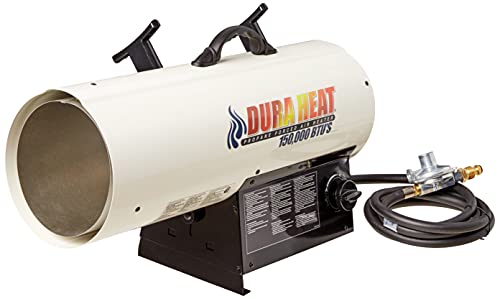
The Dura Heat GFA150A delivers 120,000–150,000 BTU and uses propane gas with a fan-forced hot air design. It operates in a broad BTU range to tailor heat output to varying space sizes, making it suitable for workshops, garages, and larger rooms. It emphasizes reliability and robust construction, ideal for frequent use in demanding environments.
Dura Heat DFA135C 135K BTU Kero Forced Air Heater

The DFA135C is a multi-fuel capable forced air heater tested with kerosene, #1 and #2 fuel oil, diesel, JP-8 and Jet-A. It features commercial-grade construction and an LED digital temperature indicator with diagnostics. This model targets heavy-duty applications where multiple fuel options are advantageous and consistent heating is required in large spaces.
Buying Guide
- BTU needs by space: Higher BTU models are better for very large areas, but consider the ceiling height, insulation, and air leakage to avoid overheating or wasted energy.
- Fuel and availability: Propane is common and widely available, but some models offer multi-fuel capabilities (like kerosene or diesel). Factor fuel cost and storage space into your decision.
- Safety features: Look for thermoelectric safety valves, high-temperature limit switches, and stable bases or handles for outdoor use. CSA or UL certifications add reliability.
- Noise and durability: Quieter burners improve work environments, especially in enclosed garages or workspaces. Durability matters for job sites and frequent transport.
- Ventilation needs: Some units are designed for unvented operation in well-ventilated areas, while others may require ventilation or auxiliary exhaust considerations in enclosed spaces.
- Power source and setup: Identify whether electricity is required for operation (some are electric-free) and include hoses/regulators in your planning to ensure compatibility with your gas supply.
- Operation time and refueling: Consider runtime on a standard cylinder and the ease of swapping tanks to minimize downtime on the job site.
When selecting a high-BTU heater, align your choice with space size, safety requirements, fuel access, and maintenance needs. The models above offer a range of options from rugged, portable units to versatile multi-fuel systems designed for demanding environments.