Finding a 240V tankless water heater that fits your needs means balancing flow capacity, energy efficiency, and space. This guide highlights five strong options, each suited to different home setups and hot-water demands. If you’re upgrading a kitchen sink, a bathroom vanity, or a small apartment, these models offer self-modulating technology, reliable temperature control, and compact footprints. The top picks below cover point-of-use and whole-home scenarios, helping you choose based on throughput, installation considerations, and user needs. A quick product table is provided to compare essentials at a glance.
| Product | Best For | Key Benefit |
|---|---|---|
| Rheem 11kW 240V Tankless Electric Water Heater | Small to mid-size apartments and single-outlet use | Self-modulating power with adjustable temperature display |
| CAMPLUX Tankless Water Heater 6kW at 240V | Under-sink or point-of-use applications | Compact, space-saving, energy-saving with two-second hot water delivery |
| Rheem 18kW 240V Tankless Electric Water Heater | Single or multi-fixture homes with higher demand | High flow up to 4.4 GPM with durable copper heating elements |
| EcoSmart ECO 11 Electric Tankless Water Heater | Space-saving, wall-mounted needs | Very compact, energy-efficient with self-modulating tech |
| Orbek 14kW On-Demand Tankless Water Heater 240V | Homes with multiple points of use | High maximum flow with 3.38 GPM and strong energy savings |
Rheem 11kW 240V Tankless Electric Water Heater
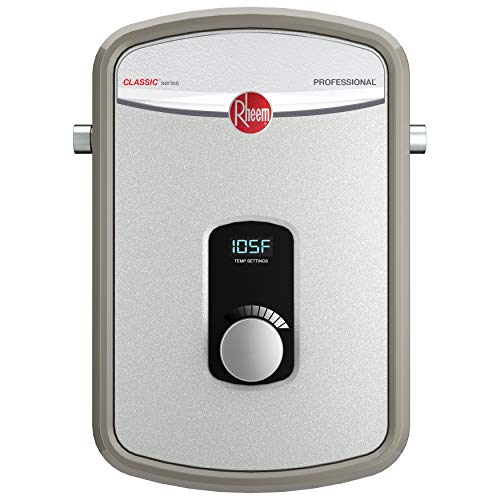
The Rheem 11kW model provides self-modulating power and an adjustable digital temperature display. With a flow rate up to 2.68 GPM, it suits compact living spaces or light-use scenarios where only one faucet or shower needs hot water at a time. Best for apartments or secondary bathrooms, this unit emphasizes steady, efficient operation over high-volume hot water. A potential limitation is lower flow capacity in multi-point scenarios where several outlets demand heat simultaneously.
CAMPLUX Tankless Water Heater Electric 6kW at 240 Volts

This under-sink unit uses self-modulating technology to heat water only as needed, offering strong energy savings—up to 60% versus traditional heaters. It’s best for point-of-use tasks like a bathroom vanity or kitchen sink where quick, consistent hot water is required with minimal space. Temperature rise data indicates around 50°F per 1.0 GPM increment, making it a practical choice for low to moderate hot-water demand. Avoid this for whole-house hot water if multiple fixtures are used simultaneously.
Rheem 18kW 240V Tankless Electric Water Heater
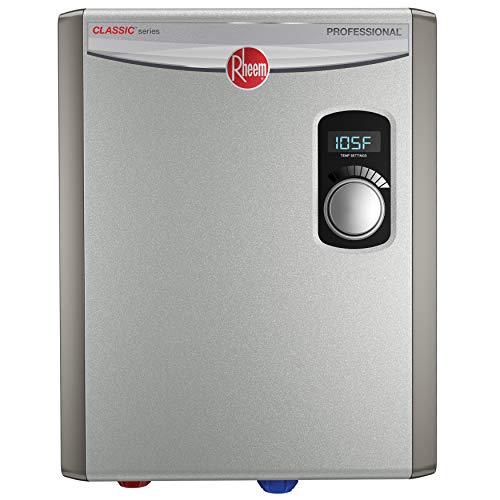
Designed for higher demand, this model features external digital thermostatic control with LED display and the most advanced self-modulation among its lineup. It supports up to 4.4 GPM, making it suitable for homes with multiple concurrent needs. Best for households that require reliable, higher-flow hot water, it can be a better option than smaller 11kW units when multiple fixtures are used at once. A limitation is that installation may require more robust electrical wiring and space considerations.
NCPYZO Tankless Water Heater Electric 240V 7000W
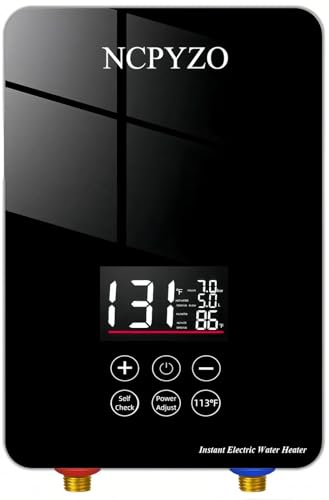
Offering 7,000 watts of power and a compact footprint, this unit provides instant hot water with an LED display and smart self-modulation. It advertises up to 131°F water and is positioned as a simple, space-saving solution for sinks or compact bathrooms. The review-ready details emphasize ease of installation and energy-conscious operation. A potential drawback is that its max flow may be more limited than higher-w wattage competitors when hot water is demanded at multiple fixtures simultaneously.
Buying Guide
What to consider when selecting a 240V tankless water heater:
- Flow rate needs: Determine your peak simultaneous hot-water demand (GPM). Higher wattage units deliver more GPM, suitable for multi-fixture use.
- Electrical requirements: Check your home’s panel capacity and wire size. Some models require dedicated circuits and thicker gauge wiring.
- Space and installation: Point-of-use units save space but may need multiple heaters for whole-home coverage. Wall-mounted options maximize space savings.
- Temperature control: Look for digital thermostats and self-modulation to maintain stable output and energy efficiency.
- Durability and components: Copper immersion elements and serviceability can influence long-term reliability and ease of maintenance.
- Safety features: Leakage protection, dry-fire protection, and temperature limits reduce risk and protect the system.
Practical comparison questions
- Is higher GPM always better for my home? Not if you mainly run one fixture at a time; a smaller unit with self-modulation can be more efficient.
- Do I need a professional for electrical work? In most cases, yes, due to code requirements and panel safety considerations.
- Should I prioritize space-saving over higher flow? If space is tight, wall-mounted and under-sink units are attractive, but ensure they meet your flow needs.
- Can these units support whole-home use? Some 18kW or 14kW models can, but verify your house’s total hot-water demand and circuit capacity.
FAQ
- What is self-modulating technology? It adjusts power usage to match flow, reducing energy waste.
- Can these units supply hot water to two fixtures at once? Some models can, but check the stated GPM rating for concurrent use.
- Are 240V models suitable for apartments? Yes, many compact 240V tankless heaters are ideal for apartments and tiny homes.
- Do these units require venting? Electric tankless heaters do not vent like gas units, simplifying installation.
- Is a digital display important? A display helps you monitor temperature and helps prevent accidental scalding.
- Do these units require professional installation? For electrical and plumbing compliance, professional installation is recommended.