Answer: For a 600 sq ft garage, ceiling-mounted, hard-wired electric heaters are typically the best option for even heat and space efficiency. The top picks below balance powerful output, safety features, and adjustable heat direction to suit various garage layouts. Best for: home garages with limited floor space, contractors, and DIY enthusiasts who need steady, point-heat control without bulky units on the floor.
Summary of selected products
| Product | Heat Output (W) | Mount Type | Special Feature | Best For |
|---|---|---|---|---|
| Mr. Heater 7,500/6,250W 240V Ceiling Mount | 6,250–7,500 | Ceiling | Adjustable louvers; Tilting head | Large, well-insulated garages |
| Comfort Zone CZ230ER 7,500W Ceiling Mount | 7,500 | Ceiling | Remote, timer, digital thermostat | Garages with remote control comfort |
| Comfort Zone 5000W Ceiling Mounted | 5,000 | Ceiling | Adjustable louvers; Durable steel | Smaller or mid-sized garages |
| InoKraft 7,500W Electric Garage Heater | 7,500 | Wall/ceiling adaptable (hardwired) | NEMA 14-50P plug option; ECO mode | Large spaces needing flexible installation |
| TEMPWARE 7,500W Hardwired Garage Heater | 7,500 | Ceiling/Wall | Digital thermostat; 2 heat settings | Precision temperature control |
Mr. Heater 7,500/6,250W 240V Ceiling Mount Garage Utility Heater
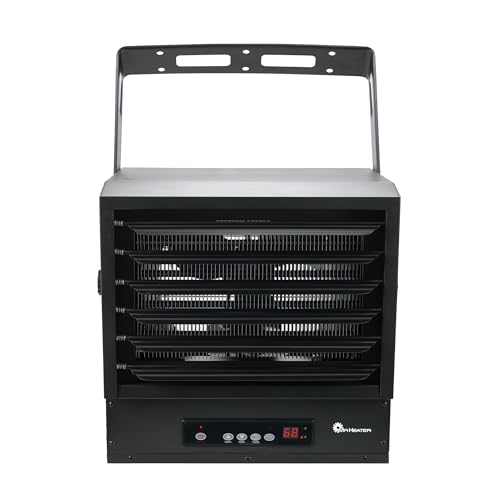
Key features: Wire heating element; High/Low heat settings (7500/6250 watts); Adjustable louvers and tilting head to direct heat. Best for: garages that need strong, controllable heat without occupying floor space. Better for larger spaces or poorly insulated areas where maximum output is needed. Caution: ceiling mounting requires proper electrical installation and clearance from combustibles.
Comfort Zone CZ230ER 7,500W Ceiling Mount Garage Heater

Key features: Space-saving ceiling mount; 1250 sq ft heating coverage; robust steel build; precise airflow with adjustable louvers. Best for: garages where floor space is at a premium and heat needs to reach across a large area. Choose this if you want wide heat distribution with durable construction. Caution: heavy unit; ensure secure ceiling mounting and professional hard-wiring.
Comfort Zone 5000W Ceiling Mounted Garage Heater

Key features: Ceiling-mount design; 5,000 watts; robust steel construction; louvers and adjustable mounting angle for precise heat distribution. Best for: smaller garages or spaces that don’t require maximum output but still need reliable, space-efficient heating. Limitation: lower max output compared to 7,500W models.
InoKraft 7,500W Electric Garage Heater

Key features: 7500W heating; ECO mode; digital thermostat; 8.2 ft power cord with NEMA 14-50P Plug included; timer 1-24 hours. Best for: users seeking precise temperature control, energy-saving ECO mode, and flexible installation. Limitation: manual assembly and wiring required; ensure electrical service supports 7,500W load.
TEMPWARE 240V Hardwired Garage Heater 7500W

Key features: Adjustable angle and two heat settings; up to 25,590 BTU; heats spaces up to 1,250 sq ft; built-in thermostat and 12-hour timer. Best for: garages needing strong, directed heat with programmable timing. Caution: high wattage means professional electrical installation is essential; ensure panel capacity and wiring are up to code.
Buying Guide
What size heater do I need for a 600 sq ft garage?
For a 600 sq ft space, look for models rated around 5,000–7,500 watts, with ceiling-mounting to save floor space. Higher wattage provides faster warmth and better performance in poorly insulated garages, while models with adjustable louvers help direct heat to the most used areas.
Should I choose ceiling-mounted or wall-mounted?
Ceiling-mounted units free floor space and distribute heat over a broad area, ideal for garages with high ceilings or crowded workspaces. Wall-mounted units can be easier to install in low-ceiling spaces but may heat more localized zones unless paired with a fan-forced design.
What safety features are important?
Look for overheat protection, durable steel construction, fully enclosed motors, and thermal cutoffs. Digital thermostats and timers help avoid unnecessary energy use and reduce temperature swings.
What installation considerations matter?
Many 7,500W models require hard-wired 240V connections and potentially a NEMA 14-50P plug. Confirm panel capacity, clearances from combustibles, and whether professional installation is required by local codes.
Which features aid energy efficiency?
Digital thermostats, programmable timers, ECO mode, and automatic shut-off when the desired temperature is achieved conserve energy. ECO-mode-equipped units are especially beneficial for maintaining steady temperatures without overshooting.
How do I compare operating costs?
Compare wattage and expected heating area. Higher wattage does not always mean higher annual energy costs if it enables shorter heating cycles and better insulation. Check for models with precise temperature control and timed operation to minimize runtime.
Key considerations at a glance
- Heater capacity vs. garage size and insulation
- Ceiling-mount vs. wall-mount feasibility
- Required electrical service and professional installation needs
- Heat distribution features (louvers, oscillation, multiple vents)
- Remote or digital controls for temperature and timing
FAQ
- Q: Can I install a 7500W garage heater myself? A: Electrical safety requires professional installation in most cases; check local codes and the unit’s wiring requirements.
- Q: What is the typical coverage for these 7500W heaters? A: Coverage varies by insulation and ceiling height but often ranges up to around 1,000–1,250 sq ft for well-insulated spaces.
- Q: Do these heaters require a remote to operate? A: Some models include remotes or digital thermostats; others use built-in controls or wall thermostats.
- Q: Are thermals or fuses included for safety? A: Most units include overheat protection and enclosed motors; confirm safety features in the product details.
- Q: Is a timer useful in a garage heater? A: Yes, timers help reduce energy use by turning the heater off after the desired heating period.
- Q: What maintenance is required? A: Regular cleaning of louvers and vents, and inspection of wiring during professional service.