Whether you’re upgrading an old system or adding supplemental heat to a chilly room, a linear convector baseboard heater can deliver steady, efficient warmth. This guide highlights top options that blend focused heat with discreet styling, moving air quickly for comfort without intrusive noise. Below you’ll find five leading models, each with practical installation notes and standout features to help you compare performance, size, and electrical needs. A quick summary table is included to spotlight core specs at a glance.
| Product | Brand | Key Specs |
|---|---|---|
| Dimplex LC3010W31 30″ Linear Baseboard | DIMPLEX | 1000W, 240V, top discharge |
| Cadet 4F1000W 48″ Baseboard Heater | Cadet | 1000W, 240/208V, 48″ |
| Cadet 6F1500W 72″ Baseboard Heater | Cadet | 1500W, 240/208V, 72″ |
| Cadet 2F500-1W 30″ Baseboard Heater | Cadet | 500W, 120V, 30″ |
| Cadet 3F750-1W 36″ Baseboard Heater | Cadet | 750W, 120V, 36″ |
Dimplex 30″ Linear Convector Baseboard Heater

The Dimplex LC3010W31 is a compact 30-inch linear convector heater designed for fast room-wide warmth. It features a shark-fin blade design on a steel tubular element that improves heat transfer for quicker heat dispersal and quieter operation. The unit is noted for being up to 42% shorter than conventional baseboards, allowing flexible placement and discreet styling. It is well-suited for bedrooms or home offices where minimal visual impact is preferred, while still delivering up to 1000 watts of heat on a 240-volt circuit. Installation typically involves standard wiring and mounting to wall studs or an appropriate enclosure.
Cadet F Series 24″ Electric Baseboard Heater
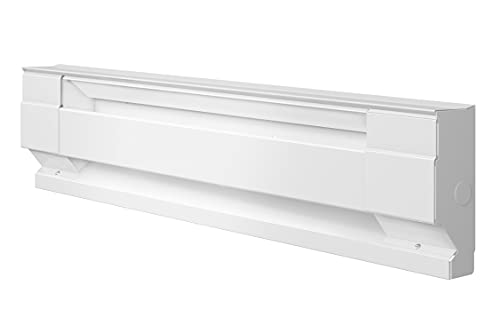
Cadet’s F Series 24″ model provides a compact heating option suitable for small spaces or as a supplementary heater. It operates at 350W (or 262W on 208V) and is available in white with steel construction. The unit emphasizes straightforward color-matching with typical room decor and relies on electric heat without a vent or duct system. Installation is facilitated by standard wiring and mounting practices, with basic service access for thermostat integration if desired. This makes it a practical choice for quickly adding warmth to compact living areas, studios, or hobby rooms.
Cadet F Series 36″ Electric Baseboard Heater
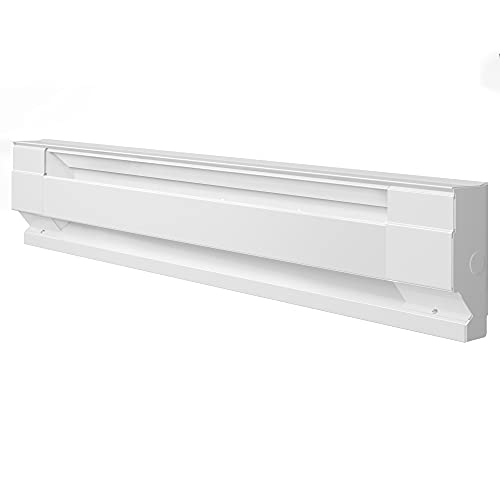
The Cadet 3F750-1W 36″ heater provides a higher heat output with 750 watts at 120V, making it suitable for mid-sized rooms or zones that require consistent, edge-to-edge warmth. Built with 25-gauge steel and a powder-coated finish, this model emphasizes durability and steady electric warmth. It includes universal wiring and pre-punched knockouts to facilitate both floor and wall mounting. A thermostat can be paired to regulate temperature automatically, ensuring energy-conscious operation in daily use, particularly in transitional seasonal periods.
Cadet F Series 72″ Electric Baseboard Heater

The 6F1500W Cadet baseboard heater spans 72 inches, providing substantial heating capacity for larger rooms. It delivers 5120 BTU (or 3840 BTU depending on voltage) and operates at 240/208 volts with wattage options of 1500W or 1125W. The all-metal construction, heavy-gauge steel, and powder-coated finish emphasize durability and long-term performance. This model is suitable for open-plan living spaces or larger bedrooms where consistent heat distribution along the baseboard is beneficial. It requires a thermostat for regulated operation and can be wired for flexible mounting configurations.
Cadet F Series 30″ Electric Baseboard Heater
The Cadet 2F500-1W model offers 500 watts of heating at 120 volts in a 30-inch footprint. It emphasizes simplicity in installation with universal wiring and 1-inch interval knockouts for mounting flexibility. The unit includes high-temperature safety shutoff for family protection and reliable continuous operation. This baseboard heater is a practical option for upgrading smaller rooms, hallways, or closets that still require efficient, line-dominated heat along the baseboard.
Buying Guide: Key Purchase Considerations
- Room size and heat requirements: Match wattage to room square footage and insulation quality. Larger rooms may benefit from longer baseboards or multiple units.
- Voltage and wiring: Most units listed operate at 120V or 240V. Confirm your electrical panel capacity and whether a dedicated circuit is needed.
- Thermostat compatibility: Some baseboard heaters work with compatible thermostats for automatic control; others may require a separate thermostat or simple on/off operation.
- Installation orientation: Wall-mounted vs floor-mounted, available mounting kits, and accessibility for wiring and maintenance.
- Durability and materials: Steel construction with powder coating generally offers longevity; consider edge protection in high-traffic areas.
- Safety features: Look for high-temperature shutoff and overheat protection to ensure safe operation in bedrooms and living spaces.
- Aesthetics and discreetness: Slim profiles and low-profile designs help blend with interior décor while providing consistent heating along walls.
- Noise levels: Linear convectors with quiet fans are typically low-noise; confirm any mechanical components that may produce audible sounds.
Overall, linear convector baseboard heaters from Cadet offer a range of wattages and lengths ideal for different room sizes, with strong emphasis on ease of installation and durable construction. The Dimplex model adds a compact design with top heat discharge and efficient distribution, appealing to spaces where discreet placement and quick warmth are priorities. When selecting, consider room dimensions, wiring readiness, thermostat integration, and desired level of heat consistency to choose the best option for American homes.