Looking for an on demand water heater that delivers instant hot water without a bulky tank? This guide highlights five reliable options, ideal for under-sink or point-of-use needs, small apartments, or spaces where you want fast hot water without waiting. Each model is suited for different setups—choose this if you want compact, plug-in convenience; pick that if you need higher flow at multiple taps; avoid others if you require shower-grade flow. The quick comparison below helps you pick the right fit.
| Product | Best For | Key Benefit |
|---|---|---|
| Tankless Water Heater Electric 110V (Under Sink) | Compact spaces, single faucet use | Fast 82°F rise at 0.3 GPM, 98% efficiency |
| Rheem 11kW 240V | Medium households, one or two points | Self-modulating power for consistent hot water |
| Orbek 14kW 240V | Higher flow, multiple uses | Max 3.38 GPM, strong performance, ETL certified |
| LECLOC 3kW 120V | Very tight budget or ultra-compact needs | LED display, safety features, best for low flow |
| EcoSmart ECO 11 | Energy efficiency and space savings | Self-modulating tech, 90% smaller than tank heaters |
Tankless Water Heater Electric 110V, Under Sink

Product: Tankless Water Heater Electric 110V, 3000W Instant Electric Water Heater, Under Sink Water Heater with Digital Display, On Demand Hot Water heater Electric for Kitchen Bathroom Washin
Best for: Small kitchens or under-sink use where you want hot water right at the point of use without a bulky system.
Why selected: This model offers 3000W heating with an LED display and rapid temperature rise (up to 82°F at 0.3 GPM). It’s compact and designed for point-of-use need, with a clear Fahrenheit/Celsius setting and safety protections like water-electric isolation and dry boil protection. Its efficiency supports energy savings in tight spaces.
Limitations: Not suitable for showers; at higher flow, outlet temperature falls. Best used for single-taucet demand or handwashing tasks rather than whole-house warm water.
Key features
- ABS construction with LED display
- 3000W, can raise water by up to 82°F at 0.3 GPM
- IPX4 waterproofing, leakage protection, auto power-off if overheating
Rheem 11kW 240V Tankless Electric Water Heater
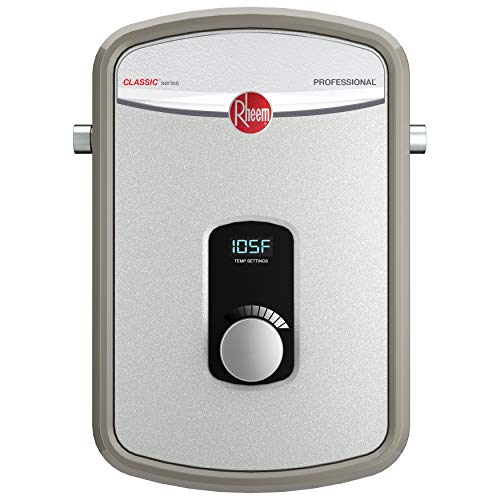
Product: Rheem 11kW 240V Tankless Electric Water Heater
Best for: Small to mid-size homes needing reliable hot water at one or two points of use.
Why selected: Features self-modulating power control and an adjustable digital temperature display, ensuring efficient operation and responsive hot water delivery up to 2.68 GPM. The modular design supports easy integration into under-sink or compact installations.
Limitation: Flow rate caps at around 2.68 GPM, which may be a consideration for simultaneous higher-demand taps or showers. No component-level performance details are provided here.
Orbek 14kW Tankless Water Heater

Product: 14kW Tankless Water Heater Electric, ORBEK On Demand Hot Water Heater 240V, Max 3.38 GPM
Best for: Households needing hotter water at multiple usage points with higher flow requirements.
Why selected: This unit offers up to 3.38 GPM and relies on a 240V, 60-amp setup with self-modulating capability. It emphasizes energy efficiency and rapid delivery of hot water, suitable for kitchens and bathrooms with multiple taps.
Limitation: Requires a robust electrical breaker and wiring (two-pole 60A), so installation is best performed by a licensed electrician.
LECLOC Mini Instant Under Sink 3kW
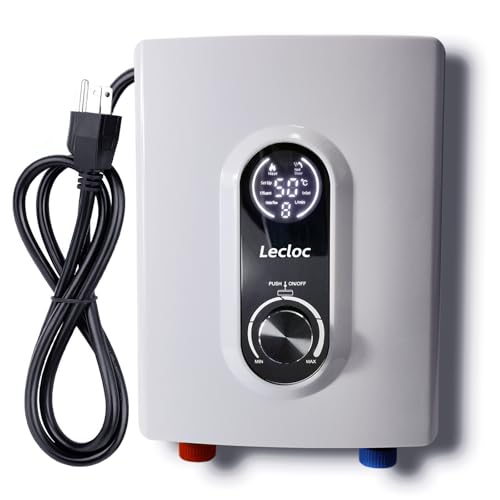
Product: LECLOC Mini Instant Under Sink Tankless Water Heater 120V 3kW
Best for: Very limited spaces and low-flow needs, such as under-sink tasks or small office setups.
Why selected: It provides a simple LED display with a large knob for temperature control, plus multiple safety protections like overheat, leakage, dry heating, and IPX4 waterproofing. It’s a practical option when outlet and single-taucet demand are dominant constraints.
Limitation: Not suitable for showers or multiple taps simultaneously; performance is highly flow-dependent.
EcoSmart ECO 11 Electric Tankless Water Heater

Product: EcoSmart ECO 11 Electric Tankless Water Heater, 13KW at 240 Volts
Best for: Energy-conscious users who want compact, space-saving design with reliable on-demand hot water for small setups.
Why selected: Self-modulating technology minimizes energy use and heat loss, with a compact form factor that makes it easy to install at point-of-use. It’s ideal where space and energy efficiency are top priorities.
Limitation: It’s designed for smaller loads; not ideal for households needing high flow at multiple points simultaneously.
Buying Guide
What to consider when choosing an on demand water heater
- Flow rate needs: Determine the number of outlets you expect to use at the same time. Higher GPM units are better for multiple taps.
- Electrical requirements: Check whether your electrical panel can support high-wattage units. Some models require dedicated circuits and larger breakers.
- Space and installation: Point-of-use models save space but may require proximity to the faucet; larger units may need wall mounting or hard-wiring.
- Temperature rise and efficiency: Self-modulating technology helps conserve energy, while some units provide precise digital temperature control for stable output.
- Safety features: Look for leakage protection, dry-boil or overheating protection, and IPX waterproofing to ensure safe operation in damp environments.
How to compare models quickly
- Best for compact setups: 110V under-sink units with 3kW power tend to be easiest to install.
- Better for higher demand: 14kW or 18kW models with 240V supply deliver more GPM at multiple points.
- Energy efficiency: Self-modulating or duty-cycle controls help reduce annual electricity use.
- Installation complexity: Plug-in models are simpler to install; hard-wired units often require professional wiring.
FAQ
- What is an on demand water heater? A device that heats water instantly as it flows through, without storing hot water in a tank.
- Can one unit supply hot water to multiple taps? It depends on the model’s GPM rating and your total demand; higher-flow units are designed for more simultaneous uses.
- Do these require professional installation? Some do not, especially plug-in 120V models; others—especially 240V or high-wattage units—may require professional wiring.
- Are there safety concerns with under-sink heaters? Yes, ensure proper clearance, electrical isolation, and compliance with local codes to prevent leaks and overheating.
- What maintenance is needed? Regular inspection of connections and ensuring the unit is free of mineral buildup can help maintain efficiency.
- Do these work in cold climates? Most will produce hot water, but outlet temperature depends on incoming water temperature; consider higher wattage in cold-water areas.