Answering the search intent: these outdoor boiler heat exchangers are best for homeowners and small businesses seeking reliable, corrosion-resistant heat transfer solutions that work with wood boilers, pools, solar setups, and forced-air systems. This guide highlights five practical options, explaining who benefits most and why each was selected. A quick buying table follows to compare core specs at a glance.
| Product | Best For | Key Capacity | Material | |
|---|---|---|---|---|
| AB 300 kBTU Heat Exchanger | Swimming pools and spas with chlorine management | 300 kBtu/hr | 316L Stainless Steel | 2″ & 1.5″ ports; 23,800 gallon pool capacity |
| ALECOIL Hydronic Heater HHA100-Pro | Remote-controlled heated spaces and garages | 100,000 BTU | Steel with remote control | Bluetooth remote; three modes |
| AB Water to Air 12×12 | Residential heating and cooling with boilers | 60,000 Btu (up to 360kBtu/hr) | Copper & aluminum with steel shell | 12 fins, 3 rows of tubes; epoxy-coated fins |
| AB Water to Air 15×20 HTL | Higher-capacity home heating and cooling | 110,000 Btu (up to 360kBtu/hr) | Copper & aluminum, steel shell | Epoxy-coated fins; energy-efficient |
| AB Plate Heat Exchanger 4×12 (20 Plates) | Floor heating and snow-melting projects | 250,000 Btu | 316L stainless steel with copper edges | 20 plates; no electricity required |
AB 300 kBTU Heat Exchanger for Outdoor Use
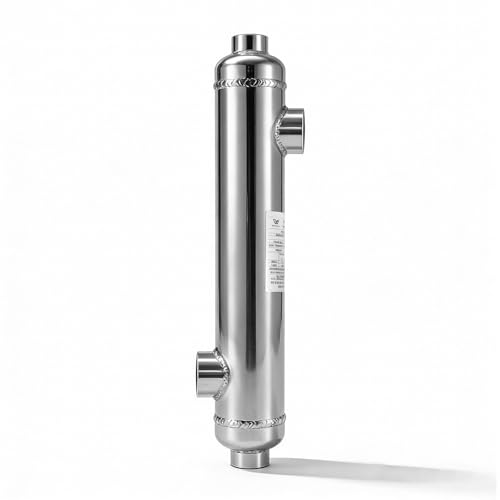
Best for: pool owners and spa users who need a robust, corrosion-resistant exchanger for chlorinated water. The 316L stainless steel construction is designed to resist chemical treatment in pools, while the unit’s 300 kBtu/hr capacity supports large pools or spa systems. It handles up to 23,800 gallons of pool water at typical temperature differentials, making it a solid all-around choice for outdoor water heating and pool circulation. Caution: verify compatibility with your pool chemistry and flow rates to ensure optimal performance.
ALECOIL Hydronic Hot Water Hanging Unit Heater HHA100-Pro

Best for: homes needing quiet, remote-controlled space heating using a building’s hot water source. The HHA100-Pro uses existing hot water lines to deliver heat with a remote control for easy temperature management, including three modes to balance room comfort with energy savings. It’s ideal for garages, workshops, and outdoor wood boiler setups. Limitation: remote range is constrained to about 33 feet (10 meters) with potential line-of-sight issues.
AB Water to Air Heat Exchanger 12×12

Best for: homeowners seeking solid heat transfer with good economy. This 60,000 Btu exchanger can reach up to 360kBtu/hr depending on setup, thanks to 12 aluminum fins and three rows of copper tubes. Steel shell and base brazing provide durability under higher pressures and temperatures. Caution: ensure your system’s flow and pressure align with the unit’s rated performance to prevent inefficiencies.
AB Water to Air 15×20 HTL Heat Exchanger
Best for: larger residential heating and cooling setups needing more capacity. The HTL15x20 provides around 110,000 Btu with potential up to 360kBtu/hr, featuring 12 fins and 3 rows of 3/8″ copper tubes. The combination of copper-tinned fins and a steel shell supports strong heat transfer while remaining energy-efficient. Choose this if your space or climate demands higher output; caution: installation should respect clearances and connection dimensions for optimal performance.
AB Plate Heat Exchanger 4″x12″ 20 Plates

Best for: floor heating, water heating, and snow melting where compact, high-efficiency plate exchangers are needed. This 20-plate model uses high-quality 316L stainless steel with copper brazed edges to resist leakage and withstand high pressures. It delivers up to 250,000 Btu per hour and supports quick, flexible connections with smooth thread. Limitation: smaller plate count means less surface area compared to higher-plate models, so expect a slightly lower maximum rate under extreme conditions.
AB Plate Heat Exchanger 4″x12″ 30 Plates

Best for: higher-demand heating projects where robust plate surface area is beneficial. This 30-plate model offers 250,000 to 330,000 Btu per hour, with copper/316L stainless steel construction and easy hookup via smooth threads. It’s a strong pick for floors, snow-melt, and large-scale heating needs. Caution: ensure your installation supports the added weight and pressure profile of a higher-plate exchanger.
AB Water to Air Heat Exchanger 12×15
Best for: balanced residential heating and cooling setups with medium capacity requirements. The 12×15 exchanger delivers about 67,500 Btu with potential up to 360kBtu/hr, using a copper-tube and aluminum-fin design plus epoxy-coated fins for durability. It’s a versatile option for multi-zone systems. Limitation: performance varies with installation configuration and climate, so sizing and ducting should be planned carefully.
Buying Guide: Key Considerations For Outdoor Boiler Heat Exchangers
- Application fit: match exchanger size and capacity to your heating load, pool volume, or space to heat. Higher BTU ratings suit larger areas or higher temperature differentials.
- Materials and corrosion resistance: stainless steel (316L) offers strong resistance to pool chemicals and outdoor exposure. Copper and aluminum blends enhance heat transfer but may require careful chemical management.
- Connection sizes: verify port diameters (commonly 1″ or 1.5″ NPT) to ensure compatibility with existing piping and pumps.
- Installation environment: outdoor units should withstand weather and temperature swings; check mounting options and clearance requirements.
- Maintenance and durability: look for epoxy-coated fins or brazed joints for longevity under high temperature and pressure.
- Remote and control features: some units offer remote temperature control or Bluetooth connectivity—consider ease of integration with your system and safety requirements.
Frequently Asked Questions
- What is a heat exchanger’s main purpose in an outdoor boiler system?
To transfer heat between water or glycol in the boiler loop and another medium (air or pool water) efficiently without mixing fluids.
- Which material is best for pool environments?
316L stainless steel is preferred for its corrosion resistance in chlorinated water and chemical-treated pools.
- Do plate heat exchangers require electricity?
No, most plate exchangers are passive heat transfer devices, though pumping and controls may require power.
- How do I choose between water-to-air and water-to-water exchangers?
Water-to-air exchangers heat air directly, useful for space heating; water-to-water exchangers transfer heat between water loops, ideal for hydronic systems and radiant floors.
- What installation considerations matter most?
Flow compatibility, pressure ratings, connection sizes, and proper mounting are crucial for performance and safety.
- Are there any cautions with high-capacity exchangers?
Higher capacity units require adequate pumping, ducting, and thermal management to avoid local overheating or pressure issues.