Answering the question: which underfloor heating thermostat system best fits my home? This guide highlights five top options that pair robust thermostats with floor heating mats or cables, helping you pick reliable control, sensor options, and safety features. Ideal buyers include DIY installers seeking straightforward setup, home renovators prioritizing energy savings, and owners wanting precise floor-temperature protection.
| Product | Brand | Sensor Type | Voltage | Best For |
|---|---|---|---|---|
| BOWSEN Programmable Thermostat | BOWSEN | Air & Floor | 120/240V | Smart, dual-sensor control for radiant floors |
| 6iE Smart WiFi Thermostat | Warmup | Air | 120/240V | App-controlled with SmartGeo for energy savings |
| LuxHeat 40sqft Kit | LuxHeat | Floor & Air | 120V | All-in-one kit with built-in GFCI and sensor |
| LuxHeat 150sqft Kit | LuxHeat | Floor & Air | 120V | Large-area tiles and laminate installations |
| VEVOR 7-Day Programmable Thermostat | VEVOR | Floor & Air | 120/240V | Flexible scheduling for varied routines |
BOWSEN Programmable Thermostat for Underfloor Heating
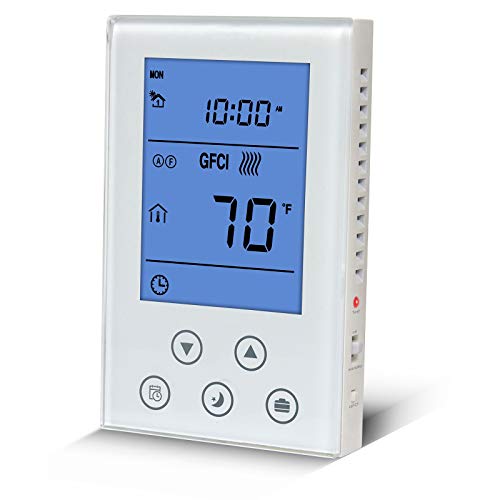
The BOWSEN thermostat supports both 120VAC and 240VAC with a maximum 15A current, delivering up to 1800W at 120V or 3600W at 240V. It includes both floor and air sensors, a built-in GFCI, and a GFCI test function for safety. This model is best for households needing dual-sensor accuracy and robust protection against electric shock. A limitation is that the GFCI component requires proper setup and periodic testing to ensure continuous protection, and users should follow the hidden menu guidance if the GFCI alert is triggered.
6iE Smart WiFi Thermostat for Underfloor Heating

The 6iE from Warmup emphasizes ease of use with an ultra-thin design and a smartphone touchscreen. It’s designed for electric underfloor heating systems and leverages SmartGeo technology to anticipate heating needs based on your location. This option is best for users who want hands-free energy management through an app and a modern, responsive interface. It is better for tech-forward homes and users who prefer automation over manual programming.
7-Day Programmable Thermostat for Underfloor Heating

This StarEEl unit offers a 7-day programmable schedule with auto-adaptive voltage (120/240V) and dual sensors for floor and air. It aims to deliver tailored comfort while cutting energy waste. It’s suitable for homes wanting scheduled, consistent warmth with floor protection, though installation notes recommend ensuring compatibility with existing heating mats or cables and noting that the product isn’t from an OEM-authorized partner for certain scenarios.
LuxHeat 40sqft Electric Radiant Floor Heating System

LuxHeat’s 40-square-foot kit includes a 120V heating cable, a UDG4 programmable thermostat with GFCI, floor sensor, alarm, and an installation-friendly uncoupling membrane. Dual-sensing and power logging help manage heat delivery and safety. This kit is best for small to mid-sized rooms like bathrooms or kitchens where reliable floor warmth and moisture resistance are priorities. A potential limitation is the need to embed the heating elements in suitable underlayment to avoid overheating or improper adhesion.
LuxHeat 150sqft Floor Heating Kit with UWG4 WiFi Thermostat
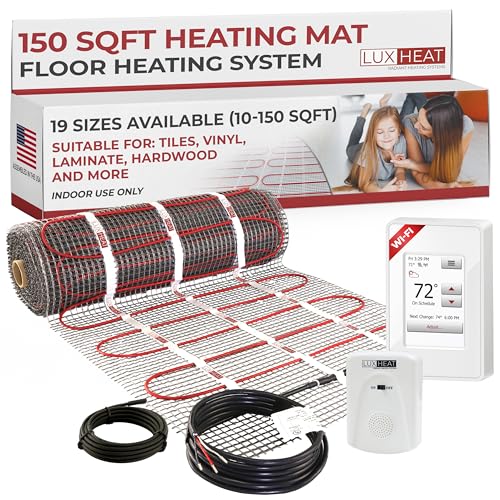
This larger LuxHeat kit is designed for bigger spaces and includes two self-adhesive mats totaling 150 sq ft, dual sensor capability, and a UWG4 WiFi thermostat with floor sensor and built-in GFCI. It suits renovations or new builds needing even warmth across multiple rooms and tiles. It requires careful layout planning to maximize heat distribution and to avoid cable overlaps in complex floor plans.
Buying Guide: Key Considerations for Underfloor Heating With Thermostats
Which thermostat features matter most? Consider sensor placement (floor vs. air), voltage compatibility (120V vs. 240V), and whether a GFCI is built into the thermostat for safety in wet areas like bathrooms and kitchens.
- Sensor strategy: Dual sensors improve comfort and protect floors. If you have hardwood or sensitive surfaces, prioritize floor sensing to avoid overheating.
- Power and compatibility: Ensure the thermostat supports your heating mats or cables and your home’s electrical circuit. Auto-adaptive voltage can simplify setup.
- Smart control: App-based control or WiFi-enabled thermostats offer remote scheduling and energy insights, beneficial for energy-saving goals.
- Safety and compliance: Built-in GFCI is a strong safety feature in moisture-prone areas. Verify local electrical codes and verify proper installation.
- Installation considerations: Some kits include uncoupling membranes or floor sensors; plan for underlayment, thinset, and tile depth to maintain proper floor height and performance.
Frequently Asked Questions
- What is the advantage of dual air and floor sensors?
Dual sensors provide precise floor temperature control and ambient room comfort, reducing the risk of overheating floor surfaces while keeping the space warm. - Do these thermostats require professional installation?
Many are designed for DIY installation, but some systems may benefit from professional electrical assistance—especially when wiring to existing circuits or upgrading panels. - Is a GFCI necessary for underfloor heating?
GFCI helps protect against electric shock in wet areas and is recommended where moisture is present, but confirm local codes and product instructions. - Can I install a large-area kit in one room?
Yes, but ensure proper mat layout and avoid cutting heating wires. Adhere to membrane or leveling requirements for tile installations. - Will a WiFi thermostat save energy?
Smart scheduling and occupancy-aware features (like SmartGeo) can reduce energy use, especially when away from home or during the day. - What should I check before buying?
Check voltage, grid compatibility, sensor types, warranty terms, and whether the kit includes a floor sensor and alarm for safety.