Finding the right 240 volt water heater means matching capacity, installation needs, and energy efficiency to your home or apartment setup. This guide highlights five solid options suited for diverse needs—from compact under-sink units to whole-home, compact-tank models. Ideal buyers include small households with limited space, apartment dwellers seeking quick hot water, or anyone upgrading an older 120V unit to a 240V system.
Summary table of selected products
- GE Appliances 18 Gallon Versatile Electric Water Heater with Adjustable Thermostat & Drain Valve, Side Port Lowboy, Point of Use, 240 Volt
- Rheem 11kW 240V Tankless Electric Water Heater
- Rheem 18kW 240V Tankless Electric Water Heater, Gray
- EcoSmart ECO 11 Electric Tankless Water Heater, 13KW at 240 Volts
- CAMPLUX Tankless Water Heater Electric 6kW at 240 Volts, Point of Use
GE 18 Gallon Versatile Electric Water Heater (240V)

Best for small homes or apartments that require a compact hot-water solution with adjustable control. This lowboy model fits in tight spaces and serves a household of 1–2 people, offering straightforward setup with standard water and electrical connections. The 240V rating enables faster heating than older 120V units, while the adjustable thermostat helps tailor comfort and energy use. The drain valve simplifies maintenance, contributing to long-term reliability.
Who it’s best for: small households or tight spaces where a traditional tall water heater won’t fit. Why selected: combination of compact size, simple 240V installation, and user-adjustable temperature for efficient usage. Caution: limited overall capacity means it’s less ideal for larger families with simultaneous hot-water demands.
Rheem 11kW 240V Tankless Electric Water Heater
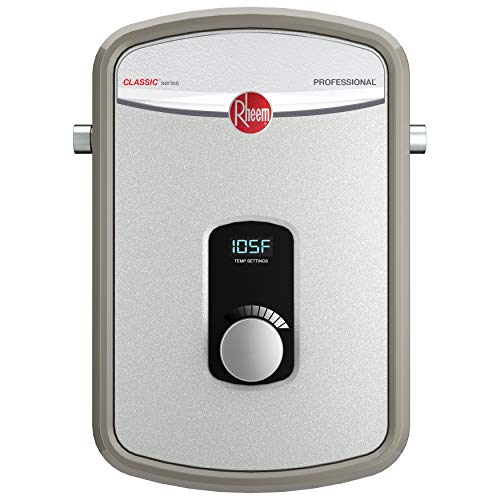
Best for singles or small apartments needing on-demand hot water with minimal footprint. The 11kW model uses self-modulating power control to adjust to demand and delivers up to 2.68 GPM, which is suitable for one or two fixtures at once. The on/off dial with adjustable digital temperature display keeps operation simple and predictable. Caution: flow capacity may drop with very cold incoming water or simultaneous heavy usage.
Rheem 18kW 240V Tankless Electric Water Heater (Gray)
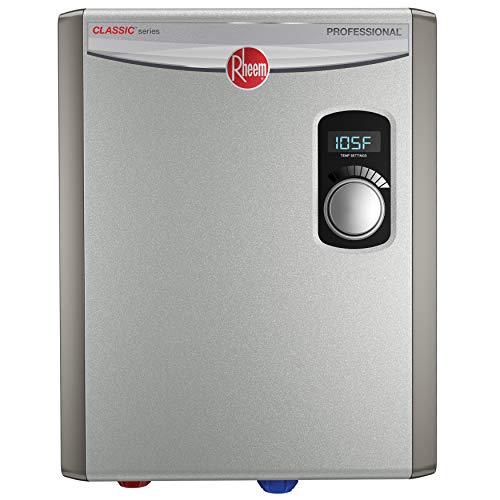
Best for households with higher hot-water needs or multiple fixtures at once. This unit features external digital thermostatic control with LED display and a robust self-modulation system that adjusts power to meet demand. Copper immersion heating elements and serviceability add to longevity. Caution: higher upfront electrical load may require an upgrade to your service panel or dedicated circuit.
Rheem 240V Heating Chamber RTEX-13 Tankless Water Heater

Best for point-of-use installations where space is at a premium and only modest hot-water flow is needed. The RTEX-13 uses self-modulating power control and external digital thermostatic control for precise temperature management. It includes compression water connections and is designed for simple, flexible mounting. Caution: flow rate is 4.4 GPM maximum, which may limit simultaneous uses.
EcoSmart ECO 11 Electric Tankless Water Heater

Best for space-saving concerns and on-demand hot water with energy efficiency. The ECO 11 is 13 kW rated at 240V, with patented self-modulating technology that heats water only as needed. It is compact—about 11.5 by 8 by 3.75 inches—and claims high energy savings due to minimal standby loss. Caution: may require electrical upgrades to support the maximum amperage in some homes.
CAMPLUX 6kW 240V Point-of-Use Tankless Heater

Best for under-sink or small office setups needing immediate hot water at a single fixture. This unit uses self-modulating technology and provides quick hot water with a small footprint. Caution: flow and temperature range are modest compared with larger or multi-point systems, so it’s best for low-demand scenarios.
Buying Guide
What to consider when choosing a 240V water heater:
- Hot-water demand: How many fixtures will you run at once? Tank or tankless? Tank models are straightforward for a small family; tankless units excel when space is limited and you want on-demand heating.
- Space and placement: Do you need a compact lowboy or a wall-mounted unit? Point-of-use options fit under sinks or in cabinets without taking up much room.
- Electrical requirements: 240V systems can require higher amperage and dedicated circuits. Verify panel capacity and wiring compatibility before purchasing.
- Flow rate and temperature stability: Tankless systems show different GPM ratings. If you have multiple users or showers, prioritize units with higher flow or better modulation.
- Maintenance and parts: Look for units with accessible components, serviceable elements, and user-friendly thermostats for easier upkeep.
- Installation considerations: Some units are designed for quick plug-and-play or standard plumbing connections; others may require professional installation.
FAQ
- What does 240V indicate on these water heaters?
It refers to the electrical supply voltage required for operation. Most 240V models need a dedicated circuit and proper wiring for safe use.
- Are tankless models better for energy efficiency?
Often yes. Tankless heaters heat water on demand, reducing standby heat loss. Efficiency depends on usage and model features.
- Can I install these in a small apartment?
Many of these units are designed for space savings or point-of-use installations. Some may require professional electrical work.
- What’s the difference between kW ratings (11kW, 18kW, 13kW) among these heaters?
Higher kW typically means higher maximum flow and faster heating, but it also requires a larger electrical supply and may draw more current.
- Is a tank model better than a tankless model for reliability?
Tank models offer simple operation and consistent hot water capacity but can waste energy due to standby heat. Tankless units minimize energy use but may require more complex installation.