Finding the right 30 inch baseboard heater depends on room size, wiring, and how you want heat distributed. This guide highlights five solid 30-inch options for American homes, explaining who they’re best for and why they stand out. Whether you want fast top heat, quiet convection, or simple installation, there’s a fit here. The top picks are suitable for spot heating along walls, bedrooms, and living spaces where stable, even warmth is valued.
| Product | Best For | Key Benefit |
|---|---|---|
| Dimplex LC3010W31 | Rooms needing quick warmth | Top heat discharge for faster air movement |
| 2F500-1W-A Mollifi | Standard 120V rooms | 500W output for typical living spaces |
| 2F500W-A Mollifi (375/500W) | Variable heat needs | Dual wattages for flexibility |
| Cadet 3F750W | Convection warmth | High-capacity convection with easy wiring |
| Stelpro Brava AB0501W | Quiet, even heat | Low-noise convection with safety features |
Dimplex 30″ Linear Convector Electric Baseboard Heater LC3010W31

Best for: quick space heating in living rooms and home offices. This model emphasizes faster warm-air distribution through top heat discharge, helping a room feel comfortable sooner than traditional baseboards. Its design uses a shark-fin blade element on a steel tube to improve heat transfer and reduce noise, making it suitable where quiet operation matters. It’s also notably smaller than many conventional baseboards, allowing flexible placement along walls without dominating a room’s aesthetics.
Why chosen: It combines speed, efficiency, and discreet styling in a 30-inch form factor. Choose this if you want noticeable warmth quickly while maintaining a low-profile look. Caution: as a high-output unit, ensure appropriate electrical capacity and wall clearance per local codes.
2F500-1W-A Mollifi Electric Baseboard Heater, 30 in, 500W

Best for: standard 120V applications in bedrooms or small living areas. This model provides 500W of heat in a 30-inch footprint, translating to about 1710 BTU hours. It’s a straightforward, reliable option for spaces that don’t require multiple heat stages.
Why chosen: Its 120V compatibility makes it easy to install in existing circuits without special wiring. Caution: output is fixed at 500W, so in larger rooms you may want additional units or a higher-capacity model for even warmth.
2F500W-A Mollifi 30″ Electric Baseboard Heater, 375/500W

Best for: rooms where heat needs vary with time of day or occupancy. The dual wattage option (375W or 500W) provides flexibility to modulate energy use while maintaining comfort. It’s a good match for living areas that don’t require full power year-round.
Why chosen: The selectable wattage helps balance temperature and energy consumption. Caution: 375W mode may be insufficient in larger spaces during winter peaks; plan for potential supplemental heating if needed.
Cadet F Series 36″ Electric Baseboard Heater 3F750W
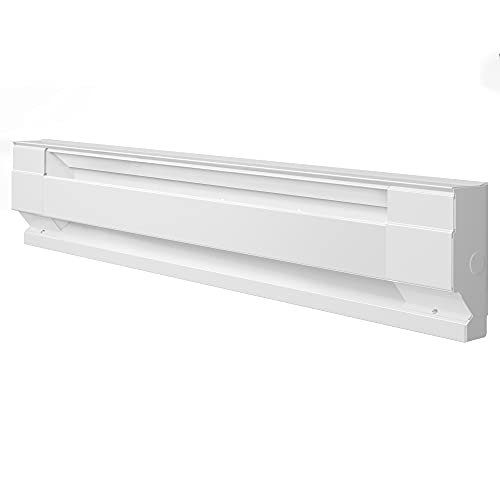
Best for: spaces needing stronger convection and quick distribution of warm air. This Cadet model delivers 750W at 240V (and 563W at 208V), supporting larger rooms or areas with higher heat demands. Its universal wiring and pre-punched knockouts make installation straightforward for professionals.
Why chosen: It emphasizes durable construction and effective convection to circulate warm air throughout the room. Caution: not a plug-in unit; hardwired installation is required, so plan for wiring and thermostat integration.
Stelpro Brava AB0501W 500W Baseboard Heater
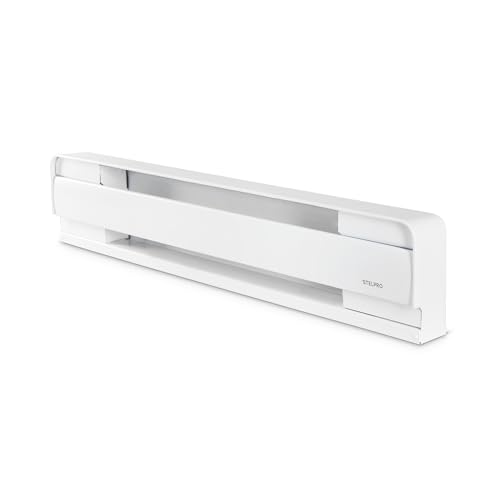
Best for: quiet, even heat in small-to-medium rooms where noise must be minimized. The Brava line uses a full-length thermal protection feature and no-end-cap design to reduce expansion noises, making it ideal for bedrooms and study spaces. It requires hard wiring and is designed for wall thermostat integration.
Why chosen: The unit focuses on consistent convection without moving parts, delivering dependable warmth while maintaining a clean aesthetic. Caution: higher-end models may require additional planning for thermostat compatibility and wiring layout.
Buying Guide: How To Choose A 30-Inch Baseboard Heater
- Heat output vs. room size: Match BTU needs to the space. Larger rooms will require higher wattage or multiple units.
- Voltage and wiring: 120V models are common and easier to install in existing circuits. 208/240V models may offer higher output but require appropriate wiring.
- Convection vs. radiant heat: Convection models circulate air for even distribution; some prefer top-heat discharge for rapid warmth in high-traffic areas.
- Installation type: Most 30-inch baseboards are hardwired. Ensure space for mounting, drywall clearance, and thermostat integration if desired.
- Thermostat control: Consider wall or built-in thermostats for precise temperature management. Some models offer multiple control options with accessories sold separately.
- Noise level: Look for no-fan designs if you need quiet operation. Steel enclosures and blade designs can reduce operational noise.
- Durability and safety: Full-length thermal protection and moisture resistance are beneficial in humid spaces. Check for edge design and finish durability.
- Compatibility with existing décor: Slim profiles and discreet finishes help blend with room aesthetics.
FAQ
- Q: Are 30-inch baseboard heaters suitable for large rooms? A: They can be, especially when paired with higher-wattage models or multiple units to cover room length and heat loss.
- Q: Do these heaters require professional installation? A: Some models are plug-in and simple to install, while others require hard wiring and thermostat integration.
- Q: What’s the difference between 120V and 240V models? A: 120V units are common and easier to install; 240V units typically deliver more heat and may be better for larger spaces but require appropriate wiring.
- Q: Can I use a baseboard heater with a wall thermostat? A: Yes, many models support thermostat control to regulate room temperature efficiently.
- Q: Are baseboard heaters safe for bedrooms? A: Yes, modern baseboards include thermal protection and no-fan designs to minimize noise and risk when installed correctly.
- Q: How long do baseboard heaters last? A: With proper maintenance and correct installation, baseboard heaters can provide reliable warmth for many years.