Choosing the right baseboard heater relay can improve efficiency, safety, and control for electric heating systems. This guide highlights five well-regarded relays and thermostats that pair well with baseboard, convectors, and similar high-voltage heaters. Each option is evaluated on compatibility, ease of installation, and notable features to help you compare at a glance.
Summary table of selected products:
| Product | Brand | Key Feature | Voltage / Load |
|---|---|---|---|
| Honeywell R841C | Honeywell | Cycle-based control with high-load switching | Up to 5,000 W per relay |
| meross Smart Thermostat | meross | Smart home integration with 4-wire high-voltage support | 16 A, 1920–3840 W depending on voltage |
| Honeywell Home RLV3150A | Honeywell Home | Non-programmable digital control for baseboards | Up to 3000 W @ 240 V |
| 77119 Heater Relay Board | Harsire | IQ2020 compatible replacement with easy install | Relay board for IQ2020, varies by system |
| Dreyoo 1/2-Pack 24V Relays | Dreyoo | UL-certified 24V SPST relays for HVAC circuits | 24 VAC, 12 FLA |
The selections span both traditional mechanical relays and modern smart thermostats, offering options for simple replacement, remote control, and high-load capacity. Each product here is documented with features that influence compatibility with typical American baseboard and convector installations.
Honeywell R841C1227/U Electric Heater Relay

The Honeywell R841C1227/U is designed for cycle-based operation in baseboard and line-voltage heating systems. It operates with each thermostat cycle, delivering reliable switching for load management. Each relay can handle up to 5,000 watts, suitable for modern residential installations that require robust control without frequent maintenance. The relays’ make/break action occurs in about 75 seconds, which supports steady temperature management while avoiding rapid on/off cycling. This unit is a solid choice for dealers and DIYers seeking a straightforward, durable baseboard relay solution with familiar Honeywell reliability.
Applications include electric baseboards, radiant ceilings, and convectors where a higher wattage load needs consistent switching. Users should confirm compatibility with their thermostat’s attachment method and ensure wiring adheres to local electrical codes. The unit’s ability to cycle with standard thermostat intervals helps maintain heat balance in rooms with variable insulation and occupancy.
Meross Smart Thermostat For Electric Baseboard

The meross smart thermostat is designed for electric baseboard and in-wall heater systems, with compatibility across Apple HomeKit, Alexa, and Google Home. It supports high-voltage installations with a maximum output load of 16 A, which translates to up to 1,920 W at 120 V or 3,840 W at 240 V. Installation is described as straightforward, typically under 30 minutes, though it requires at least four wires in the electrical box. This thermostat enables voice control and scheduling, helping to optimize energy usage and comfort in homes with smart ecosystems. It is important to note that the electric baseboard heater itself is not included and that proper high-voltage wiring is required.
Pros include convenient remote control, energy-saving features, and broad smart home integration. Consider wiring limitations and the need for a compatible 4-wire setup when planning installation. The device’s smart platform supports routine temperature adjustments and automation triggered by routines or scenes through a preferred assistant ecosystem.
Honeywell Home RLV3150A1004 Digital Electric Thermostat
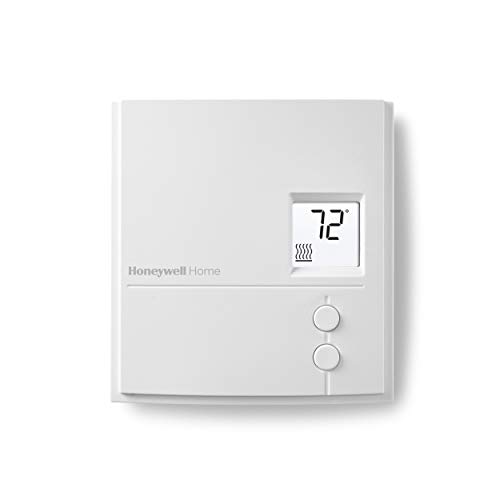
The Honeywell Home RLV3150A1004 is a non-programmable digital thermostat intended for electric baseboards and convectors. It provides simple, push-button operation with a focus on reliability and ease of use. The thermostat supports high capacities up to 3,000 W at 240 V, making it suitable for mid-sized spaces that require consistent electric heating. It is designed for line-voltage heating systems and works with 240 V circuits. This model prioritizes straightforward manual control rather than smart connectivity, which can be desirable for users seeking a no-fruss setup with predictable performance. Its simple interface helps minimize confusion when adjusting temperatures for seasonal changes.
When selecting this unit, consider room size, insulation quality, and the heater’s wattage requirements. Non-programmable control can be an advantage in environments where automated schedules are unnecessary or could cause confusion for multiple occupants. The setup is typically quick, with a focus on durability and dependable operation over long periods.
77119 Heater Relay Board For IQ 2020
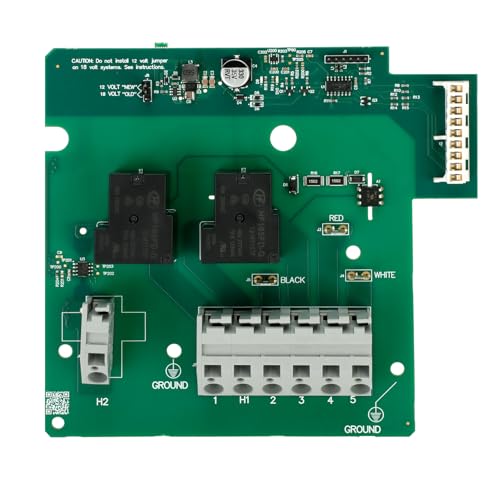
The 77119 replacement heater relay board is designed for the IQ2020 control box from model years 2001–2009.5. It includes a complete kit with a new upgraded relay board, power jumpers, and shortened screws to fit the front cover securely. The board is positioned to improve reliability and reduce fatigue on relays by optimizing how heater power connects to the circuit board. It provides straightforward diagnosis steps—such as checking voltage at H1 and H2 and monitoring the D9 LED indicator—to determine when replacement is needed. This option is ideal for users upgrading an older IQ2020 system to restore accurate temperature control and comfortable heating performance.
Consider compatibility with your existing control box, the ease of installation, and the availability of replacement parts when planning an upgrade. The kit-oriented approach can reduce downtime and ensure the system remains aligned with original equipment standards. It is best suited for readouts and diagnostics in homes with legacy baseboard setups.
Dreyoo 24V Fan Relay, 90-980 SPST

The Dreyoo 24V fan relay provides a compact, UL-certified SPST switch suitable for 24 VAC control signals. With a 90-980 rating and 12 A full-load current, these relays are designed for broader HVAC applications including blower control, humidifiers, and heat sequencers. The 24-volt coil makes them compatible with compatible thermostats and control boards, offering dependable circuit protection with a robust build. The relays are described as having UL certification for reliable performance in demanding environments, and their compact form supports straightforward installation in tight compartments alongside baseboard components.
When integrating with baseboard systems, verify the coil voltage compatibility with your control circuit and ensure the relay contacts’ current rating matches or exceeds the heater load. This type of relay is well-suited for replacing failed components within an existing HVAC control strategy that uses 24V control logic.
Dreyoo 2 Pack 24V Fan Relay
This listing offers a two-pack of 24V SPST relays from Dreyoo, designed for similar applications as the single-pack variant. With UL certification and the same 24 VAC coil, these relays support multiple circuit connections and can simplify upgrades or replacements across a baseboard or HVAC control network. The two-pack option is practical for homeowners and technicians who need redundancy or multi-zone control for larger spaces. As with the single-pack version, ensure the relay coil voltage and the contact rating align with the heater’s electrical load and the controlling thermostat or control board.
Overall, these relays emphasize compatibility with 24V control logic and robust safety certifications. When selecting, consider the number of circuits you need to manage and the ease of integration with your existing control infrastructure.
Cadet BTF2W Double Pole Baseboard Thermostat

The Cadet BTF2W offers a practical, multi-volt control for baseboard heating. It supports 240/208/120-volt operation with a 22-amp capacity and a temperature range from 40ºF to 85ºF. The installation is designed to be straightforward, with wiring considerations minimized by the thermostat’s end-of-unit accessibility. A key safety feature is the positive off position, which helps maintain a safe temperature and reduces risk of accidental overheating. This model is suitable for homeowners seeking a simple, reliable thermostat solution that can be mounted at the heater’s end for convenient access.
Consider the room’s heating requirements and whether you need a broader multi-volt capability or a dedicated 240 V setup. The positive off position adds an important safety consideration for households with children or pets, and the device’s broad voltage compatibility helps cover diverse installations.
Buying Guide: Key Purchase Considerations
When selecting a baseboard heater relay or thermostat, assess the following factors to ensure a durable, safe, and efficient installation:
- Voltage and wattage capability: Match the device’s rated load with your heater’s wattage and supply voltage. High-wattage systems may require models like the Honeywell R841C or similar units that handle 3,000–5,000 W per stage.
- Control type and integration: Decide between simple non-programmable controls, programmable thermostats, or full smart-home integrations. Smart options (like meross) enable scheduling and voice control but require compatible wiring and ecosystems.
- Wiring requirements: Some devices require 4-wire setups or specific coil voltages (24V vs. line voltage). Ensure your electrical box can accommodate the wiring without crowding.
- Safety features: Look for positive-off positions, robust enclosures, and certified components (UL, etc.) to reduce risk and improve reliability over time.
- Installation ease: Replacement parts and compatibility with existing control boxes (IQ2020, for example) can simplify upgrades and minimize downtime.
- System compatibility: Verify that the relay or thermostat works with your heating system type (baseboard, convector, radiant ceiling, etc.) and with other components in your control network.
- Future-proofing: If you plan to move toward smart homes, prioritize devices with clear app support and reliable voice assistant compatibility to avoid frequent replacements.
Depth of features varies: some units emphasize simple reliability for single-zone setups, while others pair with complex control boards for multi-zone or integrated smart-home configurations. Evaluate installation space, existing wiring, and long-term maintenance expectations to choose the option that best aligns with your home’s heating goals.