Answer: Tankless heaters heat water on demand, while tank water heaters store and continually heat a reservoir of water. This article compares five top options to help buyers choose based on space, efficiency, upfront cost, and hot-water needs. The best choice depends on household size, usage patterns, and the available fuel type. The top products below are selected for different scenarios: compact point-of-use needs, whole-home efficiency, and smart-home compatibility. See the quick reference table for a snapshot of key specs.
| Product | Type | Best For | Key Advantage |
|---|---|---|---|
| 14kW Electric Tankless (Under-Sink) | Tankless Electric | Small apartments or point-of-use outlets | Instant hot water, compact footprint |
| Propane Tankless Water Heater (4.21 GPM) | Tankless Gas | Homes needing multiple outlets with LPG | High flow for 2–3 points simultaneously |
| ThermoMate 8kW Electric | Tankless Electric | Space-saving home upgrades | Self-modulating, efficient, compact |
| MIZUDO Gas Tankless (199k BTU) | Tankless Gas | Large homes with high demand | High flow and precise control |
| Westinghouse 14kW Electric Tankless | Tankless Electric | Smart-home setups with limited space | WiFi compatibility and compact design |
Product Comparisons
14kW Tankless Electric Under-Sink Heater
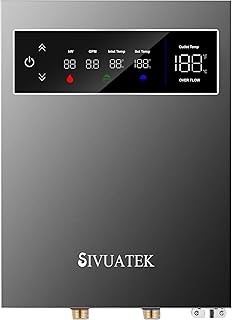
Best for: single kitchen or bathroom use where space is at a premium. This model delivers instant hot water with up to 99.8% thermal efficiency and 14 kW of heating power. It requires a dedicated 60-amp circuit and fits into tight spaces with standard 1/2″ NPT connections. Caution: ensure your electrical panel can support the 60A circuit and that one unit can meet your hot water demand for simultaneous outlets.
Propane Tankless Water Heater, 4.21 GPM

Best for: homes with LPG supply needing steady temperature control for multiple outlets. It provides 4.21 GPM under 75°C rise and up to 81,888 BTU/hour, suitable for 2–3 points of use. Caution: operates on propane only, and gas installation requires proper venting and clearance per local codes.
ThermoMate 8kW Electric Tankless

Best for: small homes or apartments needing space efficiency with two outlets. It offers 1.56 GPM at 35°F rise and uses self-modulating technology to minimize energy use. A limitation: higher flow may require additional units or a larger main to meet simultaneous needs.
MIZUDO Natural Gas Tankless, 199k BTU

Best for: busy households with high hot-water demand across multiple fixtures. This model supports up to 10.3 GPM and offers multiple safety protections with a wide temperature range (95–149°F). Caution: gas installation requires proper venting and professional installation to ensure safety and efficiency.
Westinghouse 14kW Electric Tankless, Wifi

Best for: smart-home setups seeking thermostat-like control and voice integration. This 14kW electric unit delivers up to 3.4 GPM at 62°F inlet and 105°F outlet, with a compact 60A circuit requirement and WiFi compatibility with Alexa/Google Home. Caution: effective performance depends on circuit sizing and outlet demand; not ideal for very high simultaneous hot-water needs without additional units.
Buying Guide
What should you consider when choosing between tankless and traditional tank heaters?
- Hot-water demand: Estimate peak GPM and consider simultaneous usage (showers, sinks, dishwasher).
- Fuel type and availability: Electric models require robust electrical service; gas models need proper venting and gas supply.
- Space and installation: Tankless units are compact but may require multiple units for larger homes; tanks require space for storage but simpler regulatory considerations.
- Efficiency and operating costs: Tankless generally reduce standby losses; however, initial cost and installation complexity can be higher.
- Maintenance and lifespan: Tankless systems typically have longer lifespans but may need regular descaling in hard-water areas.
- Smart features: Some models offer WiFi control and remote monitoring; assess whether this aligns with your home automation goals.
FAQ
Do tankless heaters provide endless hot water?
Yes, when sized correctly for the home’s hot-water demand, tankless heaters can supply continuous hot water within their capacity.
Are electric tankless systems suitable for whole-home use?
They can be, but may require multiple units and a substantial electrical service; single-point use models are often more practical in smaller spaces.
What is the main drawback of tankless water heaters?
Higher initial installation cost and potential increased complexity compared to traditional tank heaters.
Can I install a tankless heater myself?
Installation typically requires licensed professionals due to electrical or gas line work and venting requirements.
Will a tank heater save energy?
Tank heaters reduce standby losses but may incur higher ongoing energy use due to maintaining a large tank of hot water.