Choosing the right electric baseboard heater can improve comfort in bedrooms, offices, and living spaces without disrupting your decor. This guide highlights five well-regarded baseboard models, focusing on reliability, safety features, and ease of installation. Each option below is suited to medium to large rooms, with variations in wattage, length, and controls. Read on for clear product highlights, real-world considerations, and a practical buying guide to help you pick the best fit for your space.
Summary Of Chosen Products
| Product | Brand | Approximate Wattage | Length | Key Feature |
|---|---|---|---|---|
| Cadet F Series 48″ Electric Baseboard Heater | Cadet | 1000/750 W | 48″ | Universal wiring; safety shutoff |
| Cadet F Series 72″ Electric Baseboard Heater | Cadet | 1500 W | 72″ | Solid metal construction; thermostat-ready |
| Air Choice 33” Baseboard Heater | Air Choice | 1500 W | 33″ | Fanless design; remote thermostat |
| Comfort Zone CZ600 Electric Baseboard Heater | Comfort Zone | 1500 W | Full unit length varies | Adjustable thermostat; overheat & tip-over protection |
| EZ-HEAT CZ600 Baseboard Heater | EZ-HEAT | 1500 W | Full unit length varies | Two heat settings; stay-cool body |
Cadet F Series 48″ Electric Baseboard Heater
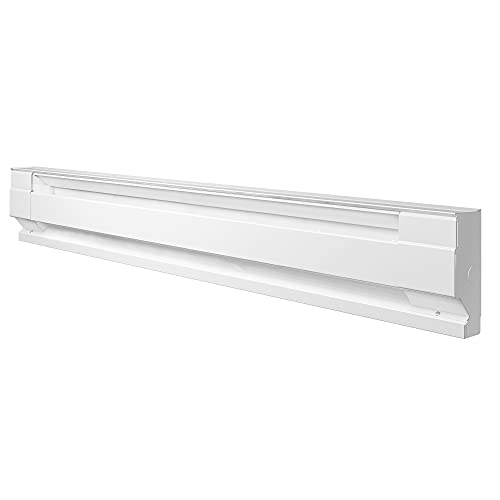
The Cadet F Series 48″ baseboard heater is designed for moderate rooms, delivering 1000/750 watts at 240/208 volts. Its compact 48-inch length offers flexible placement along walls or near windows to mitigate drafts. The unit includes universal wiring compatibility and pre-punched knockouts at 1-inch intervals, simplifying both floor and wall mounting. A high-temperature safety shutoff adds an essential layer of safety, helping prevent overheating in occupied spaces.
Cadet F Series 72 in. Electric Baseboard Heater

This Cadet 72″ baseboard model provides robust heat with a 1500-watt rating suitable for larger rooms. It’s built to maintain steady warmth and is typically paired with a compatible thermostat for precise control. The unit is crafted with durable materials for long-term performance and is marginally longer than standard units, making it a good fit where wall space permits. The product emphasizes solid construction and reliable operation in sustained-use installations.
Air Choice 33” Baseboard Heater

The Air Choice 33” baseboard heater delivers up to 1500 watts of heat with a fanless design for quiet operation. It features a wide top air outlet that becomes hot, so direct contact should be avoided. Mounting on hard surfaces like tile or concrete is recommended due to its lower bottom clearance. A remote-controlled thermostat and LED touch screen provide straightforward temperature management, with two heat modes (low and high) to tailor warmth across medium to larger rooms.
Cadet F Series 72″ Electric Baseboard Heater

This model features a 1500-watt output suitable for larger spaces, with 240/208-volt compatibility and a 72-inch form factor. Construction emphasizes durability and even heat distribution. The unit’s mounting is designed to work with standard thermostats, requiring proper installation planning to achieve optimal efficiency. A robust steel build highlights Cadet’s focus on long-lasting performance in residential settings.
Comfort Zone CZ600 Electric Baseboard Heater

The CZ600 from Comfort Zone combines 1500 watts of convection heating with an adjustable thermostat. It emphasizes safety features such as overheat protection and a tip-over switch, along with a stay-cool body to limit burn risks. The unit is designed for quiet operation, making it suitable for bedrooms or offices where muted background warmth is desirable. Its construction focuses on user-friendly installation and reliable everyday use.
EZ-HEAT 1,500 Watt Baseboard Heater

The EZ-HEAT CZ600 baseboard heater offers a straightforward 1500-watt convection heating solution with two heat settings and an adjustable thermostat. It includes a stay-cool body and overheat protection to promote safe operation in living spaces. The unit is designed for quiet performance, aiming to provide consistent warmth without distracting noise, ideal for workspaces and bedrooms that require unobtrusive heating.
Buying Guide: Key Purchase Considerations
- Room size and wattage: Baseboard heaters scale with room volume. Larger rooms typically require higher wattage (1000–1500 W or more) spread over longer heater lengths. Measure the space and calculate heat loss to choose the right wattage.
- Install location and orientation: Place baseboard units along exterior walls where drafts occur. Consider wall-mount versus freestanding options and ensure thermostatic control is accessible for convenient settings.
- Thermostat control: Look for models with adjustable thermostats and compatibility with electronic or programmable thermostats for energy efficiency. Some units include remote controls for convenience.
- Safety features: Prioritize models with overheat protection, tip-over switches, stay-cool exteriors, and high-temperature shutoffs. These features reduce risk in homes with children or pets.
- Noise and comfort: Fanless designs operate quietly, which suits bedrooms and study areas. If you prefer faster heat delivery, a convection or fan-assisted model may be more appropriate, though it may introduce mild noise.
- Installation requirements: Check required electrical supply (voltage, circuit capacity) and whether a thermostat is included or needs separate purchase. Some units require a professional install to meet electrical codes.
- Durability and materials: Steel or metal casings offer longevity and even heat distribution. Powder coatings help resist corrosion and wear over time in busy households.
- Maintenance: Baseboard heaters generally require minimal maintenance. Ensure there is clear air passage along the unit and keep the area free of dust and clutter for efficient operation.
In summary, the best baseboard heater for your space balances room size, installation constraints, and desired control features. The five options highlighted above provide a mix of fanless designs, robust wattage, and safety-focused features suitable for typical American homes. When selecting, prioritize compatibility with your existing thermostat system and verify clearances around furniture to maintain safe, efficient operation.