Keeping ponds ice-free and safe for fish and wildlife is essential during cold months. This guide highlights top electric pond heaters designed for reliability, efficiency, and safety. Each entry includes key features to help you choose the right de-icer for your outdoor pond or stock tank. Below is a quick summary of five strong options to consider.
| Product | Brand | Power | Type | Notes |
|---|---|---|---|---|
| Engtesy 500W Pond Heater | Engtesy | 500W | Submersible | Non-conductive, outdoor durability |
| K&H Ultimate Deicer | K&H Pet Products | 750W | Floating/Submersible | Thermostatic control, safety cage |
| Farm Innovators 1250W Deicer | Farm Innovators | 1250W | Floating | Built-in thermostat |
| HITOP 600W Pond Heater | HITOP | 600W | Outdoor | Fast heating, intelligent temp control |
| Laguna PowerHeat 315W | Hagen | 315W | Floating | LED indicator, thermostat |
Engtesy 500W Pond Heater

Engtesy’s 500W pond heater uses a non-conductive casing to enhance safety in various water sources, including stock tanks. The unit is designed for outdoor use with weather-resistant materials and corrosion resistance, making it a reliable submersible option. It includes a 10-foot power cord for flexible placement and straightforward operation—submerge the heater and plug in for automatic warming while minimizing oversight.
K&H Pet Products Stock Tank & Pond Heater
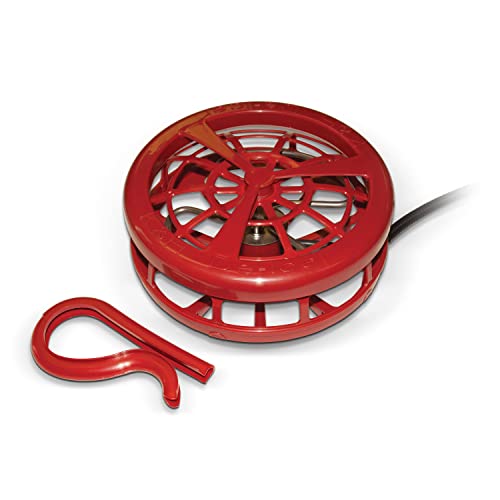
The K&H Ultimate Deicer automatically cycles on and off to prevent freezing, with multiple wattage options for energy efficiency. It can be used as a floating deicer or submerged with a full cage and cord clip included. Safe for all stock tanks and backed by a two-year warranty, this heater provides reliable protection with simple installation.
Farm Innovators 1250W Pond De-Icer

Farm Innovators provides a high-capacity 1250W floating de-icer with a built-in thermostat. Cast aluminum construction emphasizes durability and heat efficiency, while its design supports reliable operation in cold climates. The thermostat helps ensure energy-efficient heating by enabling the unit to operate only as needed to prevent icing.
HITOP Outdoor Pond Heater 600W

HITOP’s 600W pond heater is designed for outdoor ponds and small to medium-sized volumes. It features a floatable design and a long cord, with a smart temperature range of 68–72°F to maintain a safe hole in the ice. The device aims for quick, focused heating around the heater, minimizing energy use while keeping fish and water.
Laguna PowerHeat 315W Floating Heater

Laguna PowerHeat uses a compact 315W design suitable for smaller ponds or as a supplementary heater. It features a visible LED indicator to show when the unit is active and an integrated thermostat to prevent overheating. This model is safe for plastic and liner ponds and includes a lengthy 22 ft cord for flexible placement.
Buying Guide: Key Considerations For Choosing A Pond Heater
When selecting an electric pond heater, consider pond size, water type, safety, and energy efficiency. Floaters are convenient for larger, open ponds, while submersible units work well for stock tanks and smaller ponds. Thermostats help prevent overheating and reduce energy consumption, while a long power cord increases placement options. Safety features such as non-conductive casings and protective cages are important for households with animals and children. The weight and material durability determine longevity in harsh winter conditions. Finally, verify compatibility with your pond liner or plastic surfaces to avoid damage.
Usage scenarios vary by climate and pond depth. In very cold regions, higher wattage deicers ensure consistent open-water channels, while in milder climates, smaller units may suffice. For mixed environments (pond plus stock tank), choosing a model rated for both applications can reduce equipment needs. Consider the availability of a warranty and customer support when evaluating brands, as long-term reliability matters more than initial cost in winter maintenance.
In addition to these options, assess installation ease, required maintenance, and the presence of auxiliary features such as LED indicators or auto-shutoff. A comprehensive comparison of wattage, float versus submersible design, and thermostat control will help you match a heater to your pond’s specific physiology, fish population, and winter exposure.