Electric tankless water heaters deliver on-demand hot water with compact, energy-efficient designs. This article highlights five top options, comparing capacity, efficiency, installation needs, and performance to help American homeowners choose a model that meets daily demand without standby heat loss.
| Product | Brand | Key Benefit | Approximate Flow (GPM) |
|---|---|---|---|
| EcoSmart ECO 11 | EcoSmart | Self-modulating, space-saving design | Up to ~1.3–1.5 |
| Rheem 18kW 240V | Rheem | Digital control with self-modulation | Up to 4.4 |
| Orbek 14kW 240V | Orbek | High efficiency, 2–3 fixture support | Up to ~3.38 |
| Rheem RTEX-24 | Rheem | Powerful, scalable for whole-home use | Up to ~5.0 |
| WINTEMP 27kW 240V | WINTEMP | High output, WiFi-enabled control | Up to 6.5 |
EcoSmart ECO 11 Electric Tankless Water Heater

The EcoSmart ECO 11 uses patented self-modulating technology to match energy use with demand, delivering endless hot water with precise temperature control within one degree of the set point. Its compact form factor is designed for wall mounting or installation at points of use, making it an attractive option for spaces with limited storage. The unit draws 54 A and is marketed as 99% energy efficient since it only heats water when it’s called for, minimizing standby losses. This model is best suited for low to moderate hot water needs, such as single bathroom setups or smaller apartments where simultaneous high-demand points are unlikely.
Key considerations include electrical requirements and downstream temperature needs. If your home has a lower electrical service or you anticipate heavy simultaneous use (two or more fixtures at once), pairing multiple EcoSmart units or selecting a higher-capacity model might be more appropriate. The ECO 11’s small footprint helps conserve space, and its efficiency is appealing for those seeking to reduce utility bills without maintaining a tank.
Rheem 18kW 240V Tankless Electric Water Heater
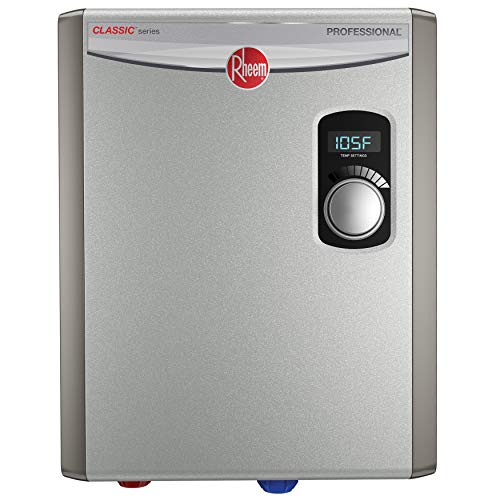
The Rheem 18kW model combines external digital thermostatic control with LED display for precise temperature management and self-modulation to align power usage with demand. Its durable copper immersion elements are field serviceable, supporting straightforward maintenance. With a maximum flow around 4.4 GPM, this unit is suitable for moderate hot water needs across a typical small home, including multiple points of use that aren’t simultaneously demanding maximum output. The design emphasizes reliability and clear readouts, enabling users to set temperatures confidently to offset incoming water temperature variations.
Considerations include electrical capacity (3 x 40 A breakers recommended) and ensuring your panel can accommodate the load. Proper installation can minimize voltage drop and optimize performance. If your home experiences frequent temperature swings or you have higher flow requirements at peak times, a larger Rheem model or portfolio expansion may be necessary to maintain comfortable temps at every faucet or shower.
Orbek 14kW Tankless Water Heater

The Orbek 14kW unit is designed for hot water on demand with up to 3.38 GPM for 2–3 points of use. It requires a 240V/60A two-pole breaker, 6 AWG wiring, and standard 1/2″ NPT water connections. The model emphasizes energy efficiency by separating water from electricity to minimize scale and corrosion, delivering hot water within seconds and potentially reducing electricity costs significantly compared with traditional storage heaters. It is well-suited for small homes or apartments where compact installation and reliable on-demand performance are essential.
Installation considerations include ensuring your electrical panel and wiring meet the specified amperage, and verifying that the water supply lines can handle the GPM rating. For homes with higher simultaneous hot water demand, pairing with another unit or selecting a higher-capacity option can help maintain consistent temperatures across fixtures.
Rheem RTEX-24 24kW 240V Electric Tankless
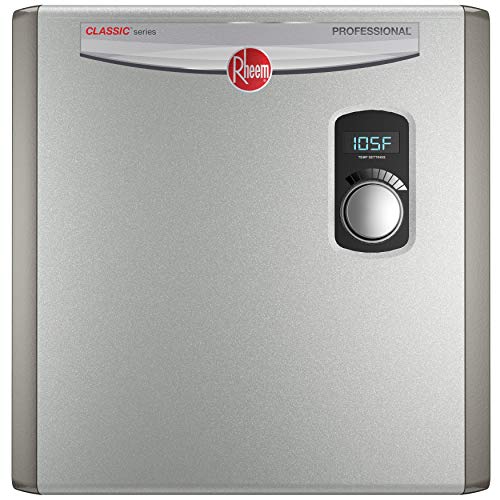
The Rheem RTEX-24 is a high-capacity electric tankless heater designed for whole-home use. It requires robust electrical support—typically 3 x 40 A breakers and a strong service panel (200 A recommended)—to consistently deliver hot water across multiple fixtures. Its adjustable ON/OFF dial and digital temperature display provide fine control, enabling temperature adjustments in 1-degree increments from 80–140 degrees F. The model’s performance is influenced by cold-water inlet temperature and the geographic distribution of hot water demands, so homeowners should assess peak usage and panel capacity before installation.
From an electrical and installation perspective, this unit is best suited for homes where the electrical system is already upgraded or where new circuits can be added. Proper sizing reduces the risk of voltage drop and ensures the unit performs as intended during peak demand seasons.
WINTEMP 27kW Tankless Water Heater

The WINTEMP 27kW model offers substantial on-demand hot water with up to 6.5 GPM. It features high-temperature stability and WiFi-enabled control for remote monitoring. The unit requires three 40 A double-pole breakers and a robust electrical service (around 250 A recommended). With a maximum amperage of 113 A, this heater is designed for larger homes or busy households with multiple simultaneous hot water demands. Its self-regulating technology helps conserve energy by adjusting power input in real time based on flow and temperature, delivering efficiency gains when compared with traditional tank heaters.
This model emphasizes advanced safety features, reliable performance across variable inlet temperatures, and the potential for significant energy savings—particularly in homes with high hot water usage. Installation should be performed by a qualified electrician to ensure proper clearances and compliance with electrical codes.
Buying Guide: Key Purchase Considerations
- Hot water demand: Estimate the number of concurrent fixtures and the desired flow rate. Higher GPM units are better for larger homes, while smaller homes may efficiently run on lower-capacity models.
- Electrical service: Electric tankless heaters draw substantial current. Verify your home’s electrical service, panel capacity, and available breakers. Some scenarios require electrical upgrades.
- Temperature rise and inlet water: Inlet water temperature and climate affect the needed capacity. Colder climates necessitate higher wattage to achieve comfortable temperatures.
- Installation footprint: Tankless units are compact but require proper mounting and ventilation near water lines. Consider space, access for service, and proximity to points of use.
- Control and monitoring: Some models offer digital displays and Wi-Fi connectivity for remote monitoring and adjustment. Consider whether you want smart features for energy management.
- Maintenance and serviceability: Copper immersion elements and field-serviceable parts can simplify repairs. Check warranty terms and available replacement components.
- Reliability vs. capacity: Higher capacity models can handle multiple simultaneous uses but may introduce higher upfront electrical requirements. Weigh the need for continuous hot water against installation complexity.
In selecting an electric tankless heater, homeowners should balance peak demand, electrical readiness, and available installation space. Reading product specifications and consulting a licensed electrician or plumbing professional can help ensure the chosen unit meets both present needs and future expansion plans.