When shopping for a vertical-venting garage heater, aim for models designed to vent exhaust upward and out of the space, reducing carbon monoxide risks while delivering steady heat. This guide highlights five top options suited for different garages and budgets. Best for larger spaces, ceiling-mounted layouts, or hard-wired installations, these selections balance performance, durability, and installation needs. Read on to compare features, optimal room sizes, and important limitations to help you choose confidently.
| Product | Best For | Vent Type |
|---|---|---|
| Mr. Heater 125,000 BTU Forced-Air Unit Heater | Large garages; propane or natural gas | Powered exhaust with vertical venting |
| Comfort Zone CZ230ER | Ceiling-mount spaces; long runtimes | Ceiling-mounted with vented airflow |
| Reznor UDXC-75 | Industrial or workshop spaces | Ceiling mount; vertical venting option |
| Vie Air 7500W Portable | Hard-wired, flexible setups | Vertical and horizontal airflow |
| VEVOR 5000W Digital Heater | Smaller garages; precise control | Wall/ceiling mount; vertical venting compatible |
Mr. Heater 125,000 BTU Forced-Air Unit Heater
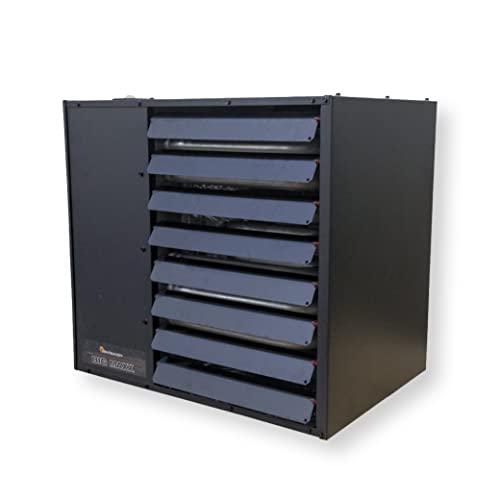
Best for: large garages or workshops that require robust, gas-fueled heat with optional liquid propane conversion. This unit supports both propane and natural gas and includes electronic ignition and a powered exhaust for safer venting. The propane conversion kit is included, enabling flexible fuel options. Limitations: installation must follow ventilation codes, and the heater is a high-capacity model that may be more than needed for small spaces.
- Electronic ignition for reliable startup.
- Powered exhaust to manage combustion byproducts.
- Liquid propane conversion included for versatile fuel choice.
Comfort Zone CZ230ER Ceiling-Mount Garage Heater

Best for: ceiling-mounted, space-saving heating in crowded garages or workshops. This 7,500-watt unit operates at 240 volts and is designed for hard-wired installation, freeing floor space. It delivers broad coverage (up to 1,250 sq. ft.) and features robust steel construction with adjustable airflow direction. Cautions: ensure proper mounting angle and clearances to avoid heat damage to nearby materials.
- Space-saving ceiling design to maximize floor area.
- Wide heating coverage suitable for large garages.
- Adjustable louvers and mounting angle for directed heat.
Reznor UDXC-75 Natural Gas Ceiling Mount Heater

Best for: commercial or industrial garages needing reliable gas heat with a compact footprint. The UDXC-75 delivers 75,000 BTU with an 83% thermal efficiency rating, supporting ceiling-mounted installation and convenient vertical venting options. Note: mounting hardware is sold separately, so plan for brackets that suit your space. Better for taller ceilings where a ceiling-mounted unit can efficiently direct warm air downward.
- Ceiling-mount capable with vertical venting compatibility.
- Good efficiency for its BTU class.
- Suitable for garages, shops, and light manufacturing spaces.
Vie Air 7500W Portable Garage Heater

Best for: flexible, hard-wired installations without relying on a plug. This unit offers both vertical and horizontal air flow to adapt heat distribution to varied layouts. It uses a remote and is intended for spaces where ceiling or wall mounting is preferred. Caution: professional electrical work is required for hard-wired installation to meet code requirements.
- Two airflow options for directed warmth.
- Hard-wired setup supports clean, plug-free operation.
- Remote control for convenient adjustments.
VEVOR 5000W Digital Garage Heater

Best for: smaller garages or workshops needing precise temperature control and safe operation. This 5,000-watt model features a digital thermostat, hardwired installation, and overheat protection. It’s ETL listed and designed to deliver steady warmth with two power settings. Limitation: heat output may be insufficient for very large spaces without supplemental units.
- Two power settings for energy-conscious use.
- Digital thermostat for stable temperatures.
- ETL listed with built-in safety protections.
Buying Guide: Vertical-Vent Garage Heaters
- Space and mounting: For ceiling-mounted units, confirm ceiling height, mounting brackets availability, and clearance from combustibles. Ceiling heat can distribute more evenly in tall garages.
- Fuel type and venting: Propane, natural gas, and electric options exist. Vertical venting helps exhaust safely outdoors; ensure your venting plan complies with local codes.
- Heat output and area: Match BTU or wattage to the garage size. Oversized units heat quickly but may waste energy; undersized units struggle in extreme cold.
- Electrical requirements: Some models require hard-wired installation; others use standard outlets. Check voltage, amperage, and whether a professional electrician is needed.
- Safety features: Look for overheat protection, automatic shutoff, and stable enclosures. For gas models, proper ventilation is essential to prevent buildup of byproducts.
- Durability and maintenance: Steel housings and corrosion-resistant finishes are preferable in damp environments. Consider ease of filter access and cleaning for longevity.
Frequently Asked Questions
- What is vertical venting, and why choose it? – Vertical venting directs combustion byproducts upward and outdoors, improving indoor air quality and reducing carbon monoxide risk in enclosed spaces.
- Can I install a garage heater on my own? – Some models are designed for do-it-yourself installation, but hard-wired or gas-vented units typically require a licensed professional to ensure safety and code compliance.
- What size garage heater do I need? – Size depends on floor area, insulation, climate, and ceiling height. Use BTU calculations or consult product guidelines to pick an appropriate wattage or BTU rating.
- Are electric garage heaters safe for continuous use? – Modern electric units with overheat protection and ETL listing are designed for extended operation when installed correctly.
- Is ceiling mounting better than wall mounting? – Ceiling mounting frees floor space and can provide even heat distribution in larger rooms, but wall-mounted units can be easier to service in smaller spaces.
- Do these heaters require professional venting? – Gas heaters usually require venting installed to code. Electric and some gas units may be installed by skilled DIYers, depending on local regulations.