Looking for reliable gas heating options for your home? This guide highlights five top picks, spanning ventless infrared heaters, vent-free blue flame models, and higher‑capacity furnaces. Each option is explained with who it’s best for, notable features, and a practical caution. Ideal buyers include small-to-medium rooms, whole‑home heating needs, and flexible installation scenarios. Below is a quick buying table to compare core details at a glance.
| Product | Best For | Key Benefit |
|---|---|---|
| MN300HPA-B Infrared Heater | Small to mid-sized homes up to 1200 sq ft | Infrared warmth with no electricity required |
| Mr. Heater 30k BTU Vent Free | Budget-friendly space heating up to 1000 sq ft | Battery ignition, no electricity needed |
| Goodman 100k BTU Furnace | Whole-house heating with high efficiency | Two-stage operation; upflow/horizontal install |
| MIZUDO Tankless Water Heater | Homes needing on-demand hot water with smart controls | WiFi/app control and precise temp stability |
| Dyna-Glo 20k BTU Wall Heater | Smaller spaces needing flexible BTU output | Blue flame technology and variable heat |
ProCom MN300HPA-B Ventless Infrared Heater
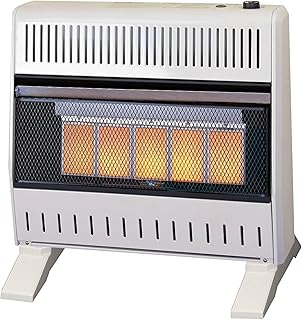
Best for primary heat in small to mid-sized living spaces where electricity isn’t available. This model delivers up to 30,000 BTU using natural gas only and heats up to 1200 sq ft. It operates without electricity and includes a piezo ignition with three manual heat settings—Low, Medium, and High. An Oxygen Depletion Sensor provides automatic shut-off for safety. Best for off-grid or emergency heating in areas with gas lines and no electrical infrastructure. Caution: Ventless operation requires proper room ventilation and adherence to manufacturer guidelines.
Mr. Heater 30,000 BTU Vent Free Blue Flame Heater

Better for flexible, medium‑sized spaces where a battery‑operated electronic ignition is acceptable. This heater emits 30,000 BTU per hour and can heat up to about 1,000 square feet. It uses a battery‑operated electronic ignition (battery included). Best for households seeking dependable gas heating with minimal electrical dependency. Limitation: Battery and ignition rely on battery health; regular replacement may be needed for consistent performance.
Goodman 96% AFUE Two‑Stage Furnace

Best for whole‑home heating with consistent efficiency and controlled output. The Goodman GR9T961004CN is a 100,000 BTU low NOx natural gas furnace featuring a two‑stage design and aluminized steel primary heat exchanger. It is suitable for upflow or horizontal installation but cannot be installed as downflow; consult model numbers beginning with GD9 for other configurations. Caution: Installation compatibility should be verified with existing ductwork and space layout.
MIZUDO 120k BTU Tankless Gas Water Heater

Best for homes needing on‑demand hot water with smart control and precision temperature. This 120,000 BTU tankless model offers indoor or outdoor installation with accessories for conversion. Features WiFi/app control, precise temperature stability within 1°F, and modular gas modulation for multi‑fixture use. Caution: Requires compatible venting and electrical connections per installation kit and local codes. Not a direct space heater; its value is warm water, not air heating.
Dyna-Glo 20,000 BTU Wall Heater

Choose this if you need a compact, wall-mounted option with flexible heat output in the 10,000–20,000 BTU range, suitable for spaces up to about 700 sq ft. It uses natural gas and features blue flame technology that mirrors central heating warmth by efficiently warming air. Caution: Fuel conversion is not permitted; ensure your gas line matches the unit’s rating and clearance requirements.
Buying Guide: Gas Heating Systems For Homes
What should you consider when selecting a gas heating system? The following questions help clarify needs and constraints.
- Heating area: Is your goal to heat a single room, a family space, or entire house? Infrared and vent-free models are often best for targeted rooms, while furnaces are for whole‑home warmth.
- Ventilation and safety: Do you require vented or ventless operation? Ventless options must follow safety guidelines for oxygen levels and room size. An oxygen depletion sensor (ODS) is a valuable safety feature.
- Fuel flexibility: Do you prefer models that run solely on natural gas, or appliances that offer modulation and zoning options for variable demand?
- Installation: Is space available for a wall heater, vented installation, or an upflow/horizontal furnace? Check clearances and ductwork compatibility for forced air systems.
- Controls: Do you want manual control, battery ignition, or smart/APP control for convenience and remote monitoring?
- Energy efficiency: Look for high AFUE ratings for furnaces and features like two‑stage heating for more even temperatures and efficiency.
Practical comparison tips
- For off‑grid rooms without electricity, consider ventless infrared heaters or gas heaters with no electrical requirement, noting ventilation needs.
- Heavier whole‑home needs benefit from a two‑stage furnace with appropriate ductwork and professional sizing.
- Tankless water heaters deliver hot water on demand, not space heating; assess whether you also need domestic hot water efficiency.
Frequently Asked Questions
- What size gas heater do I need for a 1000 sq ft room? Answer: A model in the 30,000 BTU range can often heat around 1000 sq ft, depending on climate, insulation, and ceiling height.
- Are ventless gas heaters safe for living rooms? Answer: They include safety features like oxygen depletion sensors, but require proper room ventilation and compliance with local codes.
- Can I install a gas furnace myself? Answer: No; installation must be performed by a qualified technician to ensure safety and code compliance.
- Do I need electricity for gas heaters? Answer: Some models operate without electricity, while others require it for ignition or controls.
- What is AFUE and why does it matter? Answer: AFUE measures furnace efficiency; higher AFUE means less fuel used for the same heat output.
- Is a two‑stage furnace worth it? Answer: Yes for even heat distribution and improved efficiency in many homes with variable loads.