Hardwired baseboard heaters offer reliable, zone-specific warmth with simple installation and low maintenance. This article highlights five top options suitable for American homes, covering a range of lengths and wattages to fit small rooms to larger living spaces. Each product is evaluated on heating capability, durability, and safety features to help you choose a model that aligns with your existing wiring and thermostat setup.
| Product | Brand | Wattage | Voltage | Length |
|---|---|---|---|---|
| KING 4K1210BW K Series Baseboard Heater | KING | 1000W | 120V | 4 ft |
| Cadet F Series 4F1000W | Cadet | 1000W | 240/208V | 4 ft |
| Cadet F Series 6F1500W | Cadet | 1500W | 240/208V | 6 ft |
| Cadet F Series 3F750-1W | Cadet | 750W | 120V | 3 ft |
| Cadet F Series 2F350W | Cadet | 350W | 240/208V | 2 ft |
Choosing a hardwired baseboard heater depends on room size, existing electrical capacity, and whether you need simple on/off control or a connected thermostat. Below are five models that balance performance, durability, and ease of installation, helping you upgrade comfort without complicating your electrical setup.
King 4K1210BW K Series Baseboard Heater

The KING 4K1210BW is a hardwired baseboard heater rated at 1000W at 120V, designed for continuous wall-mounted warmth. Its aluminum ribbon fin element promotes efficient heat transfer, while a full-length safety cutout helps prevent overheating. This unit is not a plug-in model, so it integrates directly with fixed electrical wiring for a clean, low-profile installation in bedrooms or living spaces. Its robust construction suits homes prioritizing steady, evenly distributed heat along the baseboard line.
Cadet F Series 48″ Electric Baseboard Heater
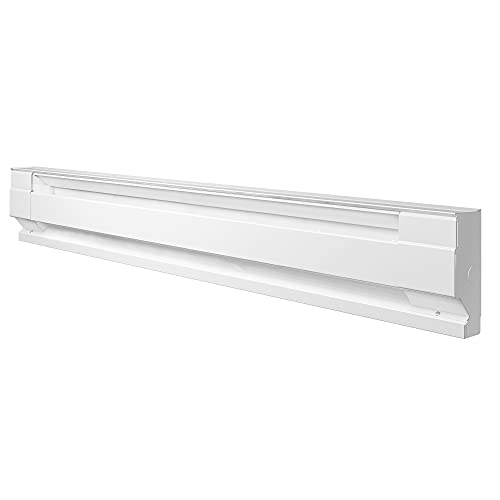
This Cadet 4F1000W baseboard heater operates at 1000W on 240/208V, delivering strong performance for small to medium rooms. It features universal wiring and pre-punched knockouts at 1-inch intervals, facilitating flexible floor or wall mounting. A high-temperature safety shutoff adds a layer of protection to ensure safe operation, especially in spaces with limited clearance or around furniture. The unit’s all-metal construction supports long-term durability in busy households.
Cadet F Series 72″ Electric Baseboard Heater

Designed for larger spaces, this 72-inch Cadet baseboard heater delivers consistent warmth with a 1500W max option when wired for 240/208V. It uses a rugged 25-gauge steel housing with a powder-coated finish for improved durability and corrosion resistance. A thermostat can regulate heat output, helping you maintain comfortable temperatures with minimal energy waste. This model suits living rooms or open-plan areas where longer baseboard runs are advantageous.
Cadet F Series 36″ Electric Baseboard Heater
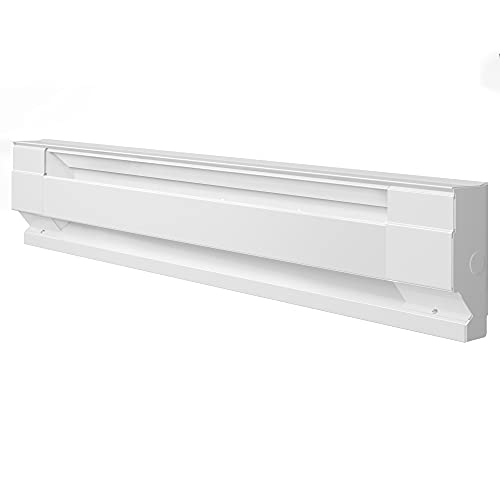
The 3F750-1W Cadet model provides 750W of heat and requires a thermostat for control. Built with 25-gauge steel and a 20-gauge junction box with ground, this all-metal unit is powder-coated for durability. Wire-in installation ensures it remains a sturdy, fixed heating solution for mid-sized rooms, with reliable heat distribution along its 36-inch footprint.
Cadet F Series 24″ Electric Baseboard Heater
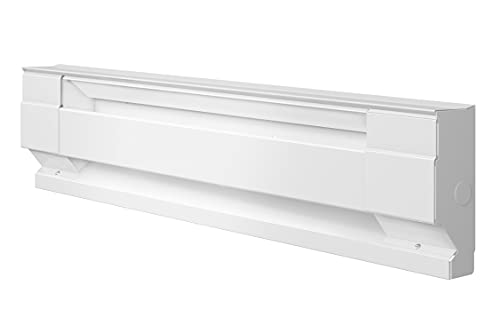
This compact Cadet 2F350W model suits smaller rooms or hallways, using 240/208V to deliver 350W of steady heat. It employs steel construction and a powder-coated finish for durability. Wiring is straightforward, and the unit can be integrated into a thermostat-controlled system to provide consistent base-level warmth without dominating the room’s aesthetic.
Buying Guide: How To Choose The Right Hardwired Baseboard Heater
When selecting a hardwired baseboard heater, consider room size, heat source compatibility, and electrical capacity. For small rooms, 350–750W units can be sufficient, while medium and large spaces may require 1000–1500W per baseboard run. If wiring is a concern, opt for models with universal wiring and clear installation guidelines to simplify the process.
Key factors to compare include: wattage and voltage (to match your home’s electrical system), length and spacing (to ensure even coverage along baseboards), safety features (such as high-temperature cutouts and overheat protection), and material quality (steel or aluminum elements influence durability and heat distribution). Thermostat compatibility matters for precise temperature control, and a timed or programmable thermostat can maximize energy savings. Finally, confirm that the model is designed for hardwired installation rather than plug-in use to meet your building codes and safety standards.
Overview of considerations by scenario:
- Small rooms (up to 120 sq ft): 350–750W units, 2–4 ft lengths, straightforward thermostat control.
- Medium rooms (120–250 sq ft): 750–1500W units, longer runs like 4–6 ft or multiple sections for even heat distribution.
- Large rooms or open-plan spaces: multiple long baseboards (6 ft or longer) at 1000–1500W per unit, with a centralized thermostat or zoned control.
- Upgrade considerations: choose units with durable steel or aluminum elements, powder-coated finishes, and robust safety shutoffs for longevity and safer operation.
These five options provide solid starting points for hardwired baseboard heating, balancing performance, durability, and installation practicality across typical American homes. Always consult a licensed electrician to verify electrical capacity and code compliance before installation.