Looking for a large electric garage heater that can warm up a big space fast and efficiently? This guide highlights five strong options, each suited to different needs—from hard-wired ceiling mounts to wall-mounted units with smart features. Aimed at garage owners, workshop users, and DIY enthusiasts, these picks balance power, safety, and ease of installation. The buyer’s focus is reliability, even heat distribution, and control options that fit your space.
Summary table of chosen products:
| Product | Best For | Key Feature | Notes |
|---|---|---|---|
| Dual Power 15,000W Electric Garage Heater | Very large spaces, need maximum heat | Dual power settings up to 15,000W | Pulls from high-wattage source; summer fan option |
| Comfort Zone 10,000W Ceiling Mount | Garage with ceiling mount preference | Wide air distribution, digital thermostat, timer | Fluent remote control, durable steel build |
| TURBRO 15,000W Smart Heater | WiFi-enabled control, large garages | Smart control + 15kW heating | Requires licensed electrician for hardwire |
| InoKraft 7,500W Ceiling/Wall Unit | Large spaces with flexible mounting | 7,500W, ECO mode, timer | NEMA 14-50P plug included |
| DR. INFRARED DR-910F 10,000W | Wall or ceiling installation | Hardwired, remote thermostat | Heavy-duty, traditional 10kW option |
Dual Power 15,000W Electric Garage Heater

Best for: spaces requiring maximum heating potential and flexible power. This unit offers dual settings that scale from 11,300W to 15,000W (approximately 38,556 to 51,180 BTUs), delivering rapid warmth across expansive garages. The ability to run without the heater as a summer fan adds seasonal versatility. Caution: ensure electrical supply can support high-wattage operation and proper installation.
Comfort Zone 10,000W Ceiling Mount Heater

Best for: garages or workshops where ceiling installation is preferred. This unit provides efficient heat distribution through a wide air pattern and a built-in digital thermostat with a 12-hour timer. The remote control adds convenience for adjustments from the workbench. Limitation: as a ceiling-mounted model, it requires proper mounting and electrical wiring by a professional if hardwired.
TURBRO 15,000W Smart Heater

Best for: users who want WiFi-enabled control and modern convenience in larger spaces. This 15kW ceiling or wall-mounted unit distributes heat quickly with an integrated fan and offers a broad temperature range and extended timer options. Best practice: professional installation is recommended due to 240V hardwiring needs and safety requirements. Caution: WiFi-enabled features require a stable network connection for reliable control.
InoKraft 7500W Electric Garage Heater

Best for: larger garages seeking flexible mounting with 7,500W of heating power and optional ECO mode. Included NEMA 14-50P plug supports convenient setup for compatible outlets. Precise temperature control helps maintain comfort with a programmable timer. Limitation: maximum reach may be lower than 15kW units; evaluate space and insulation needs for best results.
DR. INFRARED DR-910F 10,000W
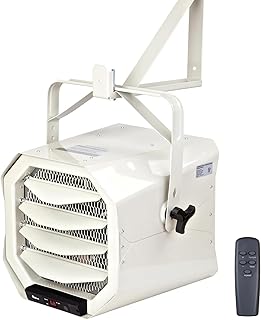
Best for: traditional hardwired setups where a robust 10,000W option is sufficient. This unit supports wall or ceiling mounting and uses a remote thermostat for convenient control. Limitation: not as feature-rich as WiFi-enabled models and requires proper hardwiring and safety considerations.
Buying Guide: Large Electric Garage Heaters
What should you consider when choosing a large electric garage heater? Start with space size, electrical capacity, and mounting preferences. Ceiling-mounted models tend to distribute heat more evenly across large areas, while wall-mounted designs can save ceiling space. If you want smart control, look for WiFi-enabled units or remotes with timers. For professional installation, confirm 240V hardwire requirements and local electrical codes.
Power needs and electrical readiness
- Evaluate your garage square footage and insulation. Larger spaces often justify 10kW–15kW units.
- Check electrical service: 240V circuits with appropriate amperage are usually required for high-wattage models.
- Consider hardwired versus plug-in options. Some models include a NEMA 14-50P plug, while others require a licensed electrician for hardwiring.
Control features and heat distribution
- Digital thermostats, timers, and remote controls improve convenience and energy management.
- Ceiling-mounted fans and wide air distribution help eliminate cold spots in large spaces.
- For larger spaces, look for units with rapid warm-up and consistent heat output.
Durability and safety
- Industrial or heavy-gauge steel builds offer durability in dusty or workshop environments.
- Overheat protection and tempered components improve long-term reliability.
- Ensure clearances from combustibles and proper mounting per codes.
Installation and ongoing use
- Professional installation is common for high-wattage hardwired models.
- Energy efficiency features like ECO modes can reduce operating costs over time.
- Remote and app-based controls require network stability and device compatibility.
Frequently Asked Questions
- What size heater do I need for a 1,000–2,000 sq ft garage?
Answer: For larger spaces within this range, 12kW–15kW units are frequently used, depending on insulation and climate demand. - Is it better to mount a heater on the ceiling or the wall?
Answer: Ceiling mounting offers broader heat distribution for large spaces, while wall mounting saves ceiling space and can be easier to install. - Do these heaters require professional installation?
Answer: Many 240V, high-wattage units require professional installation to meet electrical codes and safety standards. - What is ECO mode and does it save energy?
Answer: ECO mode reduces heating output automatically based on ambient temperature, helping to save energy without sacrificing comfort. - Do WiFi-enabled heaters need ongoing internet access?
Answer: Yes, to utilize smart control features, a stable network connection is needed. - Can I use a 15,000W heater in a standard garage?
Answer: It depends on electrical service and wiring; confirm circuit amperage and panel capacity before installation.