For buyers seeking a dependable line voltage thermostat that controls electric baseboard, convectors, or fan heaters without extra programming, these options focus on simplicity, reliability, and precise temperature control. This guide highlights five top pick thermostats, clarifies who each product is best for, and explains key considerations such as wiring, dial control versus programmable options, and safety features. The top picks cover both programmable and non-programmable models to fit different heating setups and budgets.
| Product | Best For | Key Benefit |
|---|---|---|
| Honeywell TL8230A1003 Electric Heat Digital 7 Day Programmable Thermostat | Homeowners who want energy savings and precise control | 7-day programming with ±1 F precision |
| Honeywell Home Digital Non-Programmable Thermostat for Electric Heat Only | RLV3120A1005 | Users who prefer simplicity and silent operation | Ultra-precise ±0.27°F with silent switching |
| Stelpro Line Voltage Wall Thermostat SWT1F | Residential or small commercial spaces needing no batteries or programming | Mechanical dial for quick adjustments |
| Cadet Double Pole Line Voltage Thermostat | Installers or DIYers needing full circuit shutoff | Double-pole, 4-wire design for safer disconnect |
| Stelpro Line Voltage Wall Thermostat SWT2F | Heavy-duty needs with wider voltage range | Double-pole, 22A capacity for strong heating systems |
Honeywell TL8230A1003 Electric Heat Digital 7 Day Programmable Thermostat

The Honeywell TL8230A1003 offers seven-day programming to maintain energy-saving schedules or tailor settings to a lifestyle. It features digital temperature control with precision around ±1 F, which supports better comfort and potential savings on heating costs. Best for homeowners who want programmable control to reduce heating during absences or nighttime hours, while still easy to adjust when routines change. A potential limitation is the requirement for a powered thermostat setup and familiarizing with programming options.
Honeywell Home Digital Non-Programmable Thermostat for Electric Heat Only | RLV3120A1005
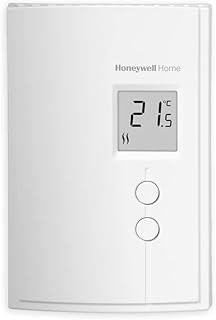
The RLV3120A1005 is a non-programmable option designed for electric baseboard heaters and convectors. It emphasizes precision, claiming a temperature accuracy of ±0.27°F and silent TRIAC switching that eliminates clicking noises. This model suits users who want straightforward, reliable control without learning schedules. The trade-off is the absence of programmable settings for automatic adjustments throughout the day.
Stelpro Line Voltage Wall Thermostat SWT1F

The SWT1F model uses a mechanical dial to control temperature without batteries or programming. It supports a broad 40–80°F range and is designed for quick, simple adjustments. Best for those who prefer a traditional dial and straightforward operation. A caveat is that it offers no remote sensing or advanced features, which may be a limitation in complex heating layouts or fluctuating climates.
Cadet Double Pole Line Voltage Thermostat

The Cadet model is designed to controls 120, 208, and 240-volt electric heaters with a double-pole, 4-wire design. It can handle up to 5,280 watts at 240V or 2,640 watts at 120V, making it suitable for larger baseboards or convectors. Best for DIY installations thanks to color-coded wires and clear wiring diagrams. A limitation is that some users may require professional assistance for complex wiring or code compliance in specific locales.
Stelpro Line Voltage Wall Thermostat SWT2F

The SWT2F is a double-pole thermostat rated for 120–277V up to 22A, designed for heavier or more demanding heating setups. It features a mechanical dial with a broad 50–90°F operating range and a clear interface. It’s ideal for spaces that require full power disconnection for energy savings or safety in cold climates. A potential limitation is that, as a dial-only device, it lacks programmable scheduling for automatic temperature shifts.
Buying Guide: Key Considerations For Line Voltage Thermostats
- Wiring configuration: Single-pole vs. double-pole impact safety and power handling. Double-pole units fully disconnect power, which is safer in cold climates.
- Programmable vs. non-programmable: Programmable models save energy by automatically lowering temperature when not needed. Non-programmable models offer simplicity and reliability.
- Voltage compatibility: Ensure the thermostat supports your system voltage (120V, 208V, 240V, or up to 277V).
- Temperature range and control type: Mechanical dials are simple and durable; digital controls offer precise settings and some memory options.
- Installation considerations: Some models are easy DIY replacements; others may require professional wiring, especially when swapping to double-pole configurations.
- Noise and comfort: Silent switching reduces thermal cycling annoyance; some users prefer silent options over traditional “click” thermostats.
Frequently Asked Questions
- What is a line voltage thermostat?
– A device that directly switches high-voltage heating elements, such as baseboard heaters, without a low-voltage control circuit. - Do I need a programmable thermostat for baseboard heaters?
– Not always, but programmable models can save energy by automatically adjusting temperatures according to a schedule. - What is the difference between single-pole and double-pole thermostats?
– Single-pole switches one leg of the circuit; double-pole switches both legs for full disconnect and greater safety. - Can these thermostats be installed by a homeowner?
– Many are DIY-friendly, especially single-pole and dial-style units. Double-pole or complex wiring may require a licensed professional. - Will a more precise thermostat save energy?
– Yes, tighter temperature control reduces unnecessary heating, contributing to energy savings when used with proper scheduling. - Which brand offers the best silent operation?
– Non-programmable models with TRIAC switching or mechanical silent designs tend to operate with minimal audible noise.