Answering the need for accurate, dependable pressure readings, this guide reviews top LP gas pressure gauges and manometers. The selected products suit home grill setups, small appliances, and professional gas systems. Best for homeowners, DIY enthusiasts, and installers who want clear, quick readings and reliable construction.
Summary Table of Key Picks
| Product | Best For | Core Benefit | Notes |
|---|---|---|---|
| Everyday propane users | Color-coded levels, weatherproof brass | QCC1/Type1 compatibility | |
| Tight spaces, flexible setups | 0-35″ W.C., 40″ hose | 1/8″ NPT with barbed connection | |
| Manifold readings | 0-35″ W.C., robust hose | Brass fittings, boxed | |
| Liquid propane planning | Color-coded, durable brass | Best for 5-40 lb tanks | |
| Low-pressure systems | Capsule style, compact dial | 0-30″ W.C. range |
CALPOSE Propane Tank Gauge, 3 Colors Coded Level Indicator
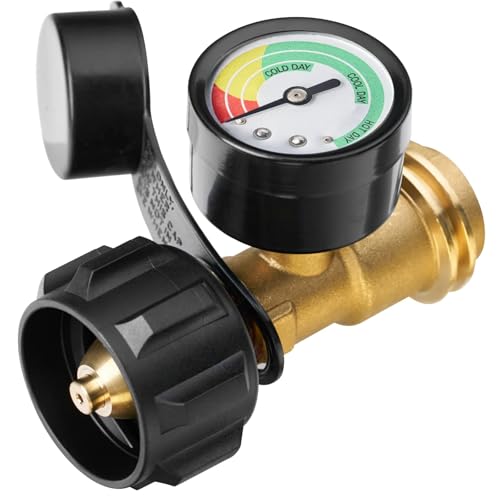
Features include a heavy-duty 100% solid brass construction and weatherproof design. It is compatible with QCC1/type1 connections and 5 lb to 40 lb propane tanks. The gauge uses a color-coded level indicator to reveal remaining fuel at a glance, helping plan refills. Best for: everyday grill users and campers who want a durable, weather-ready gauge that’s easy to read in varying temperatures.
Why it’s selected: The brass build resists weathering, and the gauge aims to show a practical level reading rather than just pressure. Caution: readings can shift with ambient temperature; use the gauge as a refill cue rather than a precise measurement of remaining fuel.
Who it’s for: Home cooks, outdoor grill owners, and small-space propane users who value straightforward visibility and rugged construction.
UHARBOUR LP Gas Manometer Pressure Tester 0-35″ W.C, 1/8″ NPT

This model is designed for measuring low gas pressures with precision across 0-35 inches of water column. It ships with a 1/8″ NPT fitting and a barbed connection for versatile attachment, plus a 40-inch hose for reach. Best for: professionals or DIYers who need flexible connections and a long hose to access tight spaces.
Why it’s selected: The kit emphasizes a secure, leak-free connection and a clear pressure range suitable for most residential gas lines. Caution: ensure compatible fittings with your regulator or pipework to avoid compatibility issues.
Who it’s for: Technicians and homeowners performing routine pressure checks on gas lines where reach and adaptability matter.
MEASUREMAN Natural Gas or LP Gas Manifold Pressure Test Kit
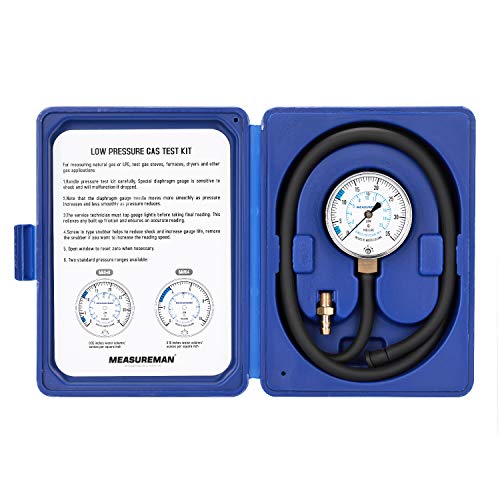
Designed for low-pressure readings across appliance manifolds, this kit includes a 2.5″ dial and a 40″ rubber hose, with 1/8″NPT male brass fittings housed in a molded plastic box. Best for: professionals or dedicated homeowners evaluating multiple appliances in a system. It covers natural gas and LP gas ranges with a range up to 0-35″W.C.
Why it’s selected: The compact dial and long hose support comprehensive, multi-point testing in a single session. Caution: the kit’s readings are relative to the setup; verify connections and seals prior to measurements.
Who it’s for: Gas technicians, apartment maintenance teams, and DIYers performing manifold-level checks.
DOZYANT Propane Tank Gauge Level Indicator Leak Detector

Key points: compatible with QCC1/Type 1 connections and 5–40 lb tanks. It offers a color-coded dial to show level status and aims to monitor usage without removing the tank. Best for: grill owners who want a quick, glanceable gauge that doesn’t require removing the cylinder.
Why it’s selected: The gauge emphasizes a practical, leak-conscious design with weather resistance in mind. Caution: the device provides estimated readings and temperature can affect pressure readings, which may cause variation with actual volume.
Who it’s for: Seasonal grillers and backyard cooks who appreciate easy-to-interpret levels and resilience in outdoor conditions.
SENCTRL 0-30 Inches of Water Column Gauge

This capsule gauge is designed for measuring low pressures, with a chrome-plated steel casing and brass wetted parts. It reads 0-30″ W.C. and is suitable for natural gas lines, propane regulators, and related tests. Best for: installations requiring a compact, robust low-pressure gauge with a single-scale display.
Why it’s selected: A capsule mechanism offers stable readings in low-pressure ranges, and brass wetted parts improve compatibility with gas media. Caution: accuracy is within ±2.5% across the range, which is acceptable for general checks but not for highly precise lab-like measurements.
Who it’s for: Home installers, small businesses, and professionals seeking a compact, reliable low-pressure gauge for system checks.
MEANLIN MEASURE 0-35” WC Manifold Gas Pressure Test Kit

Features include a 2-1/4″ dial face, a 40-inch hose, and quick-connect options with multiple NPT fittings. It ensures a solid connection to various gas systems via barbed and hex bushings. Best for: environments requiring flexibility across different gas systems, including LP and natural gas lines.
Why it’s selected: The kit’s versatility and extended hose support diverse testing scenarios. Caution: ensure correct assembly of all adapters to prevent leaks during testing.
UHARBOUR LP Gas Manometer Pressure Tester 0-35″ W.C

Best for: those who need a repeatable, accurate low-pressure reading with a flexible, long hose. It uses 0-35″ W.C range with a 1/8″ NPT connection and barbed adapter for reliable system attachment. Caution: verify the barbed connection compatibility with your hoses to avoid leaks.
BPSSDI 0-5 Psi Low Pressure Gauge

With a 2.5″ dial and a 0-5 psi range, this capsule gauge uses a 304 stainless steel case for durability and a 1/4″ NPT lower mount. Best for: low-pressure testing on air, water, and gas systems where resilience and compact size matter. Caution: reading is issued as a gauge pressure estimate; for precise measurements, confirm with a calibrated instrument.
Buying Guide: How To Choose An LP Gas Pressure Gauge
- Some gauges adjust readings for ambient temperature. If you operate in extreme heat or cold, choose a model that minimizes temperature-induced variance.
- Verify compatibility with your system’s connectors (QCC1/Type1, 1/8″ NPT, 1/4″ NPT, etc.).
- For grills and residential lines, 0-30″ W.C. or 0-5 psi covers most needs. For manifolds, 0-35″ W.C. is common.
- A larger dial (2-1/2″ to 3″) with clear markings supports quick readings, especially in dim spaces.
- Look for brass or stainless steel housings and weatherproof seals if used outdoors.
- A longer hose improves access to hard-to-reach areas; check hose material and flexibility.
- Regularly inspect for leaks, tighten fittings properly, and replace damaged components promptly.
Practical Installation Tips
- Always shut off gas supply before installing or removing gauges.
- Use compatible sealants or thread tape rated for gas systems as recommended by the manufacturer.
- Test new gauges at low pressure in a controlled environment before full system integration.
- Keep gauges away from heat sources and direct sunlight when possible to minimize reading drift.
FAQs
- What does the 0-35″ W.C range mean? It measures the pressure in inches of water column, a common unit for low-pressure gas systems.
- Are these gauges suitable for natural gas? Some are designed for both LP and natural gas; verify the product specs and fittings first.
- Why is temperature a factor? Gas pressure varies with temperature; warmer air increases pressure in the tank or line.
- Can I rely on these gauges for exact gas quantity? Gauges indicate pressure or level, which correlates with remaining volume but is not a precise measurement of liters or pounds.
- What’s the importance of a long hose? A longer hose facilitates access to hard-to-reach points and improves measurement accuracy via stable positioning.
- Should I hire a pro to install gas gauges? For complex installations or high-risk environments, professional installation is advisable.