If you need reliable propane gas regulation for homes or small businesses, these regulators provide stable pressure, safer operation, and easier installation. They are suited for homeowners, outdoor chefs, and small commercial setups that run heaters, grills, generators, or large burners. This guide compares five top options, highlights ideal use cases, and flags any limitations to help you choose confidently.
| Product | Best For | Notes |
|---|---|---|
| Propane Regulator R622H 1st Stage | Two-stage LP systems, high-capacity needs | First stage regulator; handles up to 2,500,000 BTU/hr |
| R622L 2nd Stage Propane Regulator | Residential second stage needs | Second stage with built-in safety |
| Marshall Regulator Home Supply Kit LP | Complete home LP setup | Backmount kit for whole-system use |
| R632A-JFF Integral Two Stage | Compact two-stage in one unit | POL x 3/4″ NPT; 850,000 BTU/hr |
| R232A-BBF Propane 2-Stage Regulator | Tight spaces and smaller loads | Integral 2-stage with 550,000 BTU/hr |
Propane Regulator R622H 1st Stage Gas Regulator

Best for two-stage LP gas systems in homes or small commercial setups. This first-stage regulator reduces high tank pressure to a controlled level, feeding a second stage regulator. It features 3/4″ NPT connections, a 4–12 PSI outlet range, and a max inlet of 250 PSI with up to 2,500,000 BTU/hr capacity. Not intended for indoor use or low-pressure systems; professional installation is advised. Ideal for heaters, large burners, generators, and outdoor cooking equipment.
Who it’s best for: homeowners with large LP appliances or small businesses needing robust first-stage regulation. Why selected: high flow capability and broad compatibility with two-stage LP systems.
Caution: Not designed for indoor applications or low-pressure environments. Ensure proper installation to avoid leaks or misregulation.
R622L 2nd Stage Propane Regulator

The second stage regulator, designed to follow a first stage, ensures safe, steady gas flow for home LP systems and outdoor appliances. It offers a 9″–13″ W.C. (22–32 mbar) outlet range, 3/4″ NPT connections, a maximum 1,600,000 BTU/hr capacity, and built-in safety with a relief valve and vent protection. Professional installation recommended.
Best for: upgrading or pairing with a standard first-stage system in residences or small commercial kitchens. Why chosen: reliable second-stage regulation and protective features for daily use.
Caution: Do not omit the first-stage regulator in a multi-stage setup; this unit assumes proper upstream regulation.
Marshall Regulator Home Supply Kit LP 1122H-AAJ

The Marshall regulator kit provides a ready-to-install LP supply setup for residential use. This backmount configuration is designed for reliable delivery to household appliances such as furnaces, grills, or water heaters. It combines essential components into a serviceable package for standard LP gas lines.
Best for: homeowners seeking a complete, straightforward installation with a dedicated regulator assembly. Why selected: compact, practical for typical residential loads, and easy to integrate with existing lines.
Caution: Verify compatibility with your existing propane plumbing before purchasing; misalignment can affect performance.
R632A-JFF Integral Two Stage Propane Regulator
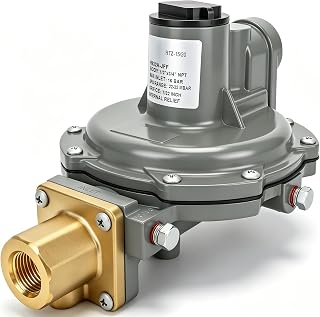
Integrated two-stage design delivers stable 9″–13″ W.C. outlet pressure in a compact package. It has POL inlet and 3/4″ NPT outlet connections, supporting up to 850,000 BTU/hr. This unit simplifies installation by combining stages, reducing leak points, and is suited for residential use with multiple LP appliances.
Best for: tight spaces and setups needing a single, compact regulator. Why chosen: space-saving two-stage solution that covers typical household demand efficiently.
Caution: Ensure proper venting and clearance in tight installations to avoid gas buildup risk.
R232A-BBF Propane 2-Stage Regulator

Integral dual-stage regulator maintains a controlled 10.2″–13″ W.C. outlet pressure, suitable for residential or small domestic loads. It handles up to 550,000 BTU/hr with a 250 psig max inlet and 1/4″ x 1/2″ FNPT fittings. The compact 7″ x 5″ x 5″ body fits tight compartments.
Best for: smaller homes or spaces with tight installation constraints. Why chosen: compact, cost-effective two-stage regulation with reliable flow for typical household devices.
Caution: Check that BTU needs do not exceed capacity during peak usage, such as multiple simultaneous heaters or grills.
Buying Guide: Choosing the Right Residential Propane Regulator
- What is a two-stage regulator and when do I need one? Two-stage regulators provide staged gas pressure reduction, reducing risk of over-pressurization and delivering steadier flow to multiple appliances. They’re common in homes with several LP devices.
- First-stage vs second-stage: Do I need both? A two-stage system often uses a first-stage regulator to reduce tank pressure, followed by a second stage. If your setup already integrates stages, a single compact unit may suffice.
- Inlet and outlet connections: Ensure 3/4″ NPT is compatible with your existing piping. Verify POL or standard NPT fittings and the correct outlet pressure range for your appliances.
- Pressure range and BTU capacity: Choose a regulator with outlet pressure in the required range (commonly 9″–13″ W.C or 4–12 PSI) and a BTU/hr capacity adequate for your largest load.
- Installation considerations: Some units require professional installation, especially when multiple stages or high-capacity systems are involved. Check venting, clearance, and safety features like relief valves.
- Space and mounting: Compact, integrated units help where space is limited. Backmount options suit built-in installations, while others are designed for freestanding setups.
FAQ
- What is “W.C.” in regulator specs? It stands for water column, a unit of pressure used for propane regulator outlet ranges.
- Do I need a professional to install a residential propane regulator? For two-stage systems or high-capacity setups, professional installation is recommended to ensure safety and correct sizing.
- Can I replace only the second stage? Yes, in many homes you can upgrade or replace the second stage for better control, keeping the first stage if it is still functional.
- What if my regulator is leaking? Immediately discontinue use and consult a qualified technician. Do not attempt to seal leaks with tape or other quick fixes.
- How do I determine the right BTU rating? Compare your largest appliance’s BTU/hr requirement and choose a regulator that can handle at least that load with some margin for simultaneous use.
- Are built-in safety features important? Yes. A regulator with relief valves and proper venting reduces risk of gas buildup and improves system safety.