If you’re seeking endless hot water for a multi-bathroom home, a gas-powered tankless unit can be a smart choice. This guide highlights five reliable options for American homes, focusing on indoor and outdoor installation, flow rates, and energy efficiency. Best for large households, basement apartments, and properties with multiple bathrooms, these models prioritize consistent temperatures and on-demand heating. The following selections are chosen for performance, installation flexibility, and practical features you can verify in product listings.
Summary of selected products
- Rheem RTG Series (Outdoor, 8.4 GPM, 180,000 BTU) — Best for outdoor, large homes
- QERPRE Tankless (Indoor, 4.3 GPM, 100,000 BTU) — Best compact indoor option with stable temperature
- Ranein 8.5 GPM (Indoor, 190,000 BTU) — Best for big homes with 4–6 water points
- Ranein 3.6 GPM (Indoor, 80,000 BTU) — Best for smaller layouts or limited points of use
- VEVOR 4.3 GPM (Indoor, 100,000 BTU) — Best balanced features with smart display
Rheem RTG Series Outdoor Tankless Gas Water Heater

The Rheem RTG Series outdoor unit delivers 8.4 GPM at 35°F rise, equating to about 180,000 BTU/hr for simultaneous showers. It is designed for outdoor installation, eliminating venting in many setups. This model is best for large households and multi-bath homes where outdoor placement is feasible, helping reduce indoor space demands. Its non-condensing design prioritizes straightforward maintenance and installation with a durable metal cabinet for wall mounting by a qualified installer.
Best for: large families or homes with multiple bathrooms that can accommodate outdoor installation. Choose this if you want high flow rates and outdoor placement to simplify venting. Caution: outdoor units may be exposed to weather and require proper protection and clearance.
QERPRE Indoor Tankless Gas Water Heater, 4.3 GPM

This indoor model provides 4.3 GPM with 100,000 BTU input. It emphasizes precise temperature control with a V3.0 Self-Modulating System to keep water within about ±1°F. Four seasonal modes help tailor performance, including a Kitchen Mode at 100°F (38°C) for dishwashing tasks and a Bathtub Mode with an alert to stop flow when the desired amount is reached. It is well-suited for apartments or homes with 2–3 water points that require reliable, energy-conscious heat on demand.
Best for: smaller homes or apartments needing steady temperature and simple control. Caution: flow may be limited for homes with high simultaneous demand if more points require hot water.
Ranein Propane Gas Tankless Water Heater, 8.5 GPM

This indoor propane model offers 8.5 GPM and 190,000 BTU for large homes serving 4–6 water points. It emphasizes safety features such as multiple combustion controls and robust airflow with a wall-mount design. Its high flow makes it a strong candidate for homes with simultaneous showers, baths, and long hot-water runs. It is well-suited for big families or properties needing reliable on-demand water across several fixtures.
Best for: large households with many simultaneous hot-water needs. Choose this if you require high flow to support several bathrooms at once. Caution: propane models require appropriate fuel access and venting considerations for indoor use.
Ranein Propane Gas Tankless Water Heater, 3.6 GPM

This smaller propane option delivers 3.6 GPM with 80,000 BTU and is designed for 2–3 water points. It focuses on efficient, compact performance with a 95–149°F adjustable range and anti-freeze protection. It is a practical choice for compact homes, cottages, or secondary bathrooms where space is limited but reliable hot water remains essential.
Best for: smaller homes or spaces with modest hot-water demand. Choose this if you need a space-saving option that still guarantees on-demand heat. Caution: lower flow may limit simultaneous usage in busier homes.
VEVOR Tankless Gas Water Heater, 4.3 GPM
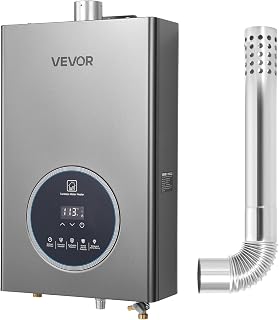
The VEVOR unit provides 4.3 GPM with 100,000 BTU and features smart temperature control plus a large LED display. It emphasizes precise temperature stability and user-friendly status indicators, making it a balanced option for whole-home use. The device includes multiple built-in protections, supporting safe operation in indoor settings while delivering dependable hot water for daily routines.
Best for: households seeking a balanced feature set with easy-to-read controls. Choose this if you want clear temperature readouts and straightforward operation. Caution: ensure your indoor space has adequate venting and clearance for safe exhaust management.
Buying Guide
Key questions to guide your purchase:
- What is my peak hot-water demand? Determine how many fixtures may run at once and choose a unit with a higher GPM if needed.
- Outdoor vs. indoor installation: Do you have outdoor space for ventless outdoor models, or do you need a compact indoor unit?
- Fuel type and ventilation: Is propane or natural gas available, and are the required venting arrangements in place?
- Temperature stability: Do you benefit from tight temperature control (±1°F) for showers and kitchens?
- Efficiency and safety features: Look for self-modulating systems, anti-freeze protections, and clear safety protections for family use.
FAQ
What size tankless gas water heater do I need for a 3-bath home?
Aim for at least 7–8 GPM with sufficient BTU output to handle peak demand. If many showers and appliances run simultaneously, consider higher flow models like 8.5 GPM or more.
Are outdoor tankless units weatherproof enough for year-round use?
Outdoor units are designed for weather exposure, but protect them with proper shading and weatherproof housing, and follow local code requirements.
Is a tankless unit better than a traditional tank for energy savings?
Tankless units heat on demand, which can reduce standby losses and overall energy use compared to electric tanks. Gas models’ efficiency varies by design and usage.
Do I need professional installation?
Yes. Gas tankless systems require venting, gas line assessment, and electrical work. A qualified installer ensures proper clearances and code compliance.
What maintenance is required?
Regular service includes checking venting, flushing the system to remove mineral buildup, and inspecting connections to prevent leaks.