If you’re shopping for a tankless water heater for an RV or trailer, you want on-demand hot water, reliable performance at altitude, and simple installation. The top options below are propane-powered, 12V DC models designed for off-grid camping, full-time RV life, or weekend trips. Each product is best suited to a different traveler profile—from occasional campers to full-time nomads. The summary table helps compare key features at a glance.
| Product | BTU | GPM | Door Type | Best For |
|---|---|---|---|---|
| APUS RV Tankless Water Heater (Black Door) | 68,000 | 3.9 | Black | Long showers, high-altitude trips |
| RV Tankless Water Heater 12V (Somokg) | 65,000 | 3.9 | Lockable | Off-grid and cold-weather camping |
| RV Tankless Water Heater (Xenjum) | 65,000 | 3.9 | Dual Outlets | Interior/exterior hot water supply |
| APUS RV Tankless Water Heater (White Door) | 68,000 | 3.9 | White | Standard RV compartments, high-altitude ready |
| RV Tankless Water Heater (RVPart Pro) | 60,000 | variable | Black | High-efficiency, microcomputer control |
APUS RV Tankless Water Heater — Black Door

Best for RVers who want strong hot water performance at higher elevations. This unit delivers up to 68,000 BTU and 3.9 GPM, starting with a low flow. It is compact enough to fit most RV openings and supports 12V DC power plus propane for off-grid use. The 9,800 ft elevation capability and a freeze-protection feature make it suitable for mountain trips and cold-weather camping. Caution: ensure compatible ducting and fittings in your RV model, as installation varies by coach design.
Somokg RV Tankless Water Heater — 12V, 65,000 BTU

Best for off-grid campers seeking rapid, on-demand water with lightweight components. It delivers up to 3.9 GPM and heats water quickly with precise temperature control. The unit’s resistance to freezing and upgraded ignition at high altitudes (up to 9,840 ft) supports varied climates. Caution: heavier use may still depend on adequate propane supply and proper venting; verify installation clearances before mounting.
Xenjum RV Tankless Water Heater — Dual Outlets
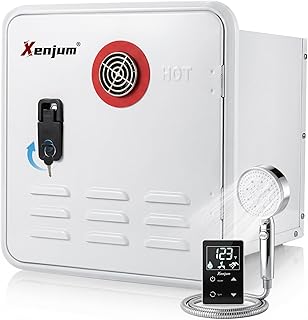
Best for RVs needing hot water throughout the coach, including exterior use. It provides instant hot water at up to 65,000 BTU and 3.9 GPM, with interior and exterior outlets. The remote control allows temperature adjustments between 95°F and 123°F. Caution: dual outlets require careful plumbing to ensure even distribution; check your RV’s water line routing for optimal performance.
APUS RV Tankless Water Heater — White Door

Best for travelers who prefer a lighter color option and reliable high-altitude performance. Like the black-door model, this unit delivers 68,000 BTU and 3.9 GPM with 12V DC compatibility and remote control. It also includes intelligent freeze protection for mountain trips. Caution: ensure the white door finish aligns with your RV’s aesthetic and exterior exposure to sunlight, which may affect heat absorption and exterior wear.
RVPart Pro Tankless Water Heater — Black Door

Best for users prioritizing precise temperature control and built-in diagnostics. This unit uses a high-efficiency copper heat exchanger and a microcomputer panel to adjust water temperature between 95°F and 123°F. It includes a 150 PSI pressure reducing valve for simpler installation. Caution: the 60,000 BTU rating is lower than other 68K units, which means it may run less vigorously in high-demand scenarios.
Buying Guide: Tankless RV Water Heaters
- What size BTU and GPM should I choose? Consider typical shower flow and hot water needs. Higher BTU and 3.9 GPM generally satisfy longer showers, but installation space and propane supply influence performance.
- Do I need high-altitude capability? If you camp in mountains or cold regions, choose models with high-altitude operation and freeze protection.
- Should I prefer dual outlets? Dual-outlet designs distribute hot water to multiple fixtures, which helps in larger RVs or when outdoor cleaning is common.
- Is remote temperature control important? Remote tuning saves trips to the cabinet and keeps temperature consistent across uses.
- What about installation and power needs? Most units run on propane with 12V DC support. Verify compatible fittings, venting requirements, and space in your RV’s utility bay.
- What safety features matter? Look for automatic ignition, flame adjustment, and freeze protection to prevent cold-water bursts or wasted propane.
FAQ
- Q: Can these heaters work with existing RV water lines? A: Most are designed to replace standard RV water heaters and use common NPT fittings, but check your model’s dimension and inlet/outlet layout.
- Q: Do they require a large propane tank? A: They burn propane as needed; ensure your propane supply matches your travel pattern and demand.
- Q: Are they suitable for winter camping? A: Yes, many models include freeze protection and high-altitude operation, but proper installation and power supply are essential.
- Q: Is remote control essential for installation? A: It improves convenience and temperature stability, especially in larger RVs or outdoor setups.
- Q: Do these units vent outside the RV? A: Most RV tankless heaters vent combustion gases externally; follow the manufacturer’s installation instructions to ensure proper venting.