Direct answer: If your home uses a heat pump with auxiliary or emergency heat, these thermostats are designed to manage two heating modes and a cooling mode for reliable comfort and better energy use. The top picks below are best for households with heat pumps that rely on auxiliary heat, with options for manual or non-programmable control. Each product is suited to a different use case, from simple setups to more adjustable schedules. A quick buyer’s table is included to compare core specs at a glance.
Summary table of selected products (quick reference)
- Aowel 2 Heat/ 1 Cool Non-Programmable Thermostat — Best for simple, wall-compatibility with heat pumps that include aux heat.
- Thermostat for Heat Pump (Non-Programmable) — Best for quick DIY install and visibility with backlit display.
- Heagstat H721 Non-Programmable Heat Pump Thermostat — Best for straightforward control with emergency heat option.
- Suuwer Non-Programmable Heat Pump Thermostat — Best for clarity and compatibility with 2H/1C setups.
- Honeywell Home X2P Programmable Thermostat — Best for flexible scheduling in single-stage systems with heat/cool.
Aowel 2 Heat/ 1 Cool Non-Programmable Thermostat
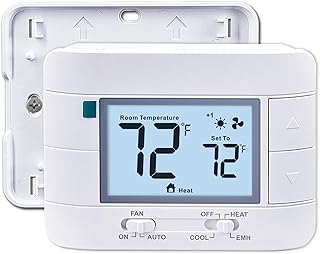
This non-programmable model supports up to 2 heat/1 cool for heat pump systems with aux or emergency heat, making it suitable for homes that require a simple override when auxiliary heat runs. It also includes a room temperature and humidity monitor, useful for maintaining comfort and system efficiency. Best for homeowners who want a straightforward thermostat that works with heat pumps and does not require complex scheduling. Limitations include compatibility checks needed to ensure it fits your wall and system type.
Who it’s best for: Homeowners who want a straightforward, easy-to-install thermostat for a heat pump with auxiliary heat and who do not need programmable schedules.
Why selected: It covers aux/emergency heat configurations and provides a clear display for quick adjustments, fitting many standard heat pump configurations.
Caution: Verify compatibility with your HVAC system and confirm wall size to avoid visible gaps or misfit on an older wall plate.
Thermostat for Heat Pump (Non-Programmable)
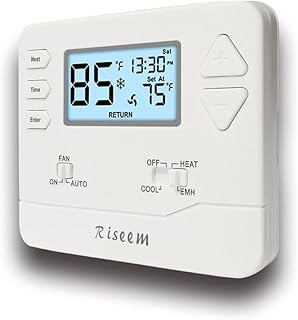
This non-programmable thermostat is designed for heat pumps and single-stage conventional systems, offering 2 heat/1 cool or 1 heat/1 cool configurations. It features a backlit LCD display and simple controls for a user-friendly experience. It can be powered by 24VAC or two AAAs, and many systems don’t require a C-wire. Best for DIY installers seeking a straightforward upgrade without complex programming.
Who it’s best for: Households needing a quick, simple install with clear controls and flexible power options.
Why selected: The dual power supply and clear display make it easy to operate, especially for users who want reliable control without programmable schedules.
Caution: Not compatible with some multi-stage, line-voltage, or hybrid heating systems; check your system type before purchase.
Heagstat H721 Non-Programmable Heat Pump Thermostat
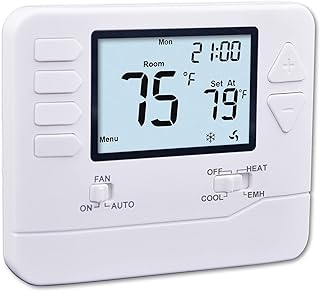
This model provides 2 heat/1 cool operation with manual control and a straightforward interface. It supports emergency heating with a manual switch and clarifies compatibility with 2H/1C heat pump setups. It is not compatible with certain multi-stage, line voltage, or mini-split systems. Best for users who want manual operation with clear limits and warnings about compatible systems.
Who it’s best for: Buyers who prefer a simple, manual thermostat to manage heat pump operation and emergency heat.
Why selected: Clear limitations help prevent incompatible installations, and the manual operation is easy for all ages to use.
Caution: Not suitable for complex multi-stage or high-voltage configurations; verify your system’s stage count before buying.
Suuwer Non-Programmable Heat Pump Thermostat

The Suuwer model supports up to 2 heat/1 cool for heat pump systems with aux or emergency heat and is compatible with most 24V conventional single-stage systems. The blue backlit display provides easy visibility for middle-aged or elderly users. It emphasizes careful installation review in the product images to avoid miswiring or incompatibility. Best for users seeking a cost-effective, visually clear thermostat for standard heat pumps.
Who it’s best for: Homeowners who want a non-programmable, straightforward thermostat with a blue backlight for easy readability.
Why selected: Broad compatibility with single-stage systems and aux heat options makes it a versatile option for many heat pump setups.
Caution: Follow installation instructions closely to avoid wiring issues or misfits with your current HVAC configuration.
Honeywell Home X2P Programmable Thermostat
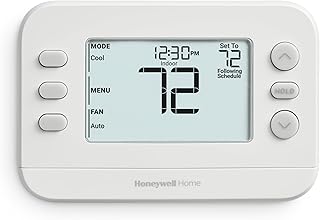
The Honeywell Home X2P supports single-stage heating and cooling with a 5-2 day schedule. It provides programmable options in a compact, white unit, with features that enable customized display and reminders for filter changes. This model is suitable for users who want a programmable experience with straightforward setup.
Who it’s best for: Homes seeking programmable control with a reliable, widely-supported brand and a familiar user interface.
Why selected: The 5-2 schedule offers meaningful energy-saving options while maintaining ease of use, making it a solid upgrade for routine HVAC control.
Buying Guide: How To Choose The Right Thermostat With Auxiliary Heat
- System compatibility: Confirm your heat pump type (with aux/emergency heat, or without) and the number of heating/cooling stages supported by the thermostat. Mismatches can lead to malfunction or inefficient operation.
- Power needs: Some units require a C-wire; others can operate on 24VAC or batteries. Choose based on whether your system provides a reliable common wire.
- Programmable vs non-programmable: If you want automatic schedules, select a programmable model. For simple overrides, a non-programmable unit is often sufficient.
- Display and accessibility: Backlit screens help readability in dim spaces; consider blue backlit displays for high contrast. Ensure button layout is intuitive for all users.
- Installation ease: Look for models with universal sub-base compatibility and clear wiring diagrams. DIY installation should take roughly 30 minutes for many models.
- Emergency heat handling: Some thermostats require manual activation for emergency heat; others automate this function. Verify how your chosen unit handles emergency heat and any limitations.
- Wall compatibility: Check the wall plate size and mounting compatibility to avoid visible gaps or wall damage, especially when replacing older thermostats.
Frequently Asked Questions
- What is auxiliary heat on a heat pump?
Auxiliary heat provides supplemental heat to boost comfort when outside temperatures are very cold or when the heat pump alone cannot meet the demand. - Can I install a thermostat with auxiliary heat myself?
Yes, many non-programmable and programmable models are designed for DIY installation, but verify system compatibility and follow the wiring diagrams carefully. - Do all thermostats support two heating stages and one cooling stage?
No, some models support only certain configurations. Always check the product features for 2H/1C or other stage limits. - Is a C-wire required for these thermostats?
Some models can operate without a C-wire, using batteries or 24VAC power, while others require a C-wire for reliable operation. - Should I choose programmable or non-programmable for a heat pump?
Programmable units are better for energy savings with scheduled changes; non-programmable units are simpler and easier to use for basic needs. - What is the main limitation to watch for when buying?
Double-check compatibility with your specific heat pump model and ensure the thermostat supports aux/emergency heat if you rely on it.