This guide helps buyers choose the right wall-mounted or under-sink hot water heater for quick, on-demand hot water. It’s ideal for small kitchens, bathrooms, and apartments where space is limited. The top picks below cover tankless and small-tank options, suiting different needs like space efficiency, continuous hot water, and simple installation. Each product is evaluated for who it’s best for and why it stands out in the crowd.
| Product | Type | Best For |
|---|---|---|
| Tankless Electric 110V 3000W (xwdzswgs) | Tankless | Apartment kitchens; quick, compact hot water |
| VEVOR 8-Gallon Mini Tank | Small Tank | Under-sink storage with steady supply |
| BOSCH Tronic 3000 T 2.5-Gallon | Small Tank | Under-sink use; easy, independent install |
| CAMPLUX ME60 6-Gallon | Small Tank | Point-of-use with energy savings |
| ThermoMate ES250 2.5-Gallon | Small Tank | Compact, versatile under sink setup |
Tankless Electric 110V 3000W (xwdzswgs)

Best for compact spaces needing instant hot water without storage. This 3000W unit offers on-demand warmth with an LED display for quick temperature checks. It can raise water temperature by up to 82°F at low flow (0.3 GPM) or up to 131°F at light flow (0.5 GPM). The unit is designed for point-of-use installation, ideal under a sink or in a small bathroom. It supports Fahrenheit or Celsius settings and includes safety features like anti-overheat protection and IPX4 waterproofing. A note: not ideal for showers with high flow requirements.
- Best for under-sink or compact bath/kitchen setups
- Not suitable for high-flow showers
- Requires vertical installation to avoid heating element issues
VEVOR 8-Gallon Mini Tank Water Heater

Best for steady hot water supply in small homes or apartments without running out quickly. This 1440W appliance uses a 8-gallon tank with stainless steel construction and polyurethane insulation to minimize heat loss. It includes a temperature/pressure safety valve for enhanced safety and supports continuous use around the clock. Suitable for under-sink installation to supply hot water for kitchens and laundry. Limitation: larger capacity means it’s not as space-saving as true tankless units.
- Longer warm-water availability for multiple uses
- Under-sink installation recommended
- Not a compact tankless option
BOSCH Tronic 3000 T 2.5-Gallon
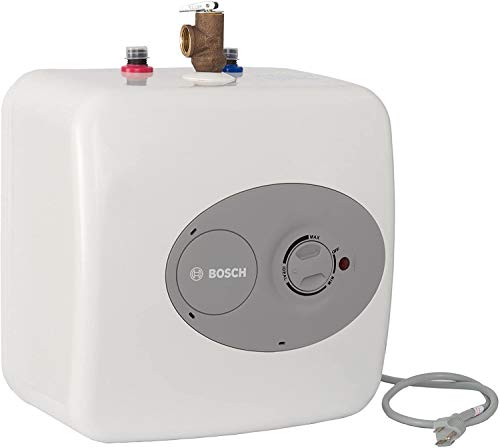
Best for independent, point-of-use hot water with high thermal efficiency. The 2.5-gallon Bosch model is compact enough to fit under most sinks and operates at 120V. It features a glass-lined tank for durability and ease of maintenance. Independent installation means it can be added to an existing hot water system or used alone for immediate hot water when needed. A limitation is the smaller tank size, which may require more frequent reheating for high-demand households.
- Thermal efficiency around 98%
- Easy, independent installation
- Limited hot water capacity for high-demand use
CAMPLUX ME60 6-Gallon

Best for energy-conscious users who want a reliable point-of-use solution. The CAMPLUX ME60 features built-in insulation to reduce heat loss and a glass-lined tank for durability. With three temperature settings (50°F–149°F), it provides flexible hot water for kitchens and bathrooms. It’s UL listed and designed for easy installation under the sink or on the wall. Limitation: 6 gallons may still run short for frequent large tasks or multi-user households.
- Compact, wall- or floor-mountable
- UL listed with adjustable temperatures
- Moderate capacity may require planning for larger households
ThermoMate ES250 2.5-Gallon

Best for tight spaces where quick hot water is needed with minimal footprint. This 2.5-gallon unit provides instant hot water with a 1440W element and a 50°F to 149°F adjustable temperature range. The tank uses a fused porcelain enamel glass lining to resist corrosion and scale buildup, while an incoloy heating element improves durability. A caveat: smaller capacity means more frequent reheating for larger households or heavy usage.
- No-wait hot water for single-spot use
- Corrosion-resistant interior and durable components
- Limited by small capacity for high-demand scenarios
Buying Guide: Key Considerations For Wall Mounted Or Under-Sink Heaters
- Hot water demand: Evaluate gallons per minute (GPM) and whether you need instant hot water for one faucet or multiple taps at once.
- Tank vs. tankless: Tankless models save space and water by heating on-demand, but some still have flow limits. Tanks provide steady supply but take more space.
- Install location: Under-sink units require vertical or horizontal space; wall-mounted designs save countertop real estate and simplify routing.
- Power and energy: Check wattage (e.g., 110V 3000W vs. 1440W) and ensure your electrical system can support the unit. Higher wattage yields faster heating at given flow.
- Safety features: Look for IP ratings, dry-boil protection, over-temperature shutoffs, and pressure relief valves to reduce risk.
- Materials and durability: Glass-lined tanks and stainless steel interiors offer longer life and resistance to corrosion.
- Maintenance needs: Glass-lined tanks are generally easier to maintain; check accessibility for servicing.
- Space and aesthetics: Compact dimensions and sleek finishes suit modern kitchens and bathrooms while preserving style.
Frequently Asked Questions
- What size wall-mounted heater do I need? — Choose based on flow needs. For a single sink at 0.3–0.5 GPM, a 110V 3000W tankless unit is often sufficient; for more simultaneous uses, opt for a larger or dual-tane solution.
- Is a tankless heater better than a tank heater for under-sink use? — Tankless saves space and reduces standby heat loss; tanks provide larger immediate hot-water reserves but require more space.
- Do these units require professional installation? — Many can be installed by confident DIYers, but electrical and plumbing connections may require a licensed professional for safety and code compliance.
- Can I install these outdoors? — Most are designed for indoor use; outdoor exposure may require weatherproofing and different models.
- What maintenance is needed? — Periodic inspection of connections, ensuring no leaks, and flushing the tank (for tank models) to remove sediment.
- Will these work with a high-demand kitchen or laundry setup? — For multiple simultaneous hot-water needs, a larger-capacity tank or a robust tankless system is recommended.