Answering the question most buyers ask: which wall-mounted gas heater fits my space and needs? This guide highlights five top options, from compact vented models to dual-fuel units. It covers who each product is best for, how they heat, and potential limitations. Whether you want fast heat for a small living area or a robust solution for a workshop, you’ll find clear, comparison-ready details to inform your choice.
Product Quick Comparison
| Product | Best For | Heat Output | Notes |
|---|---|---|---|
| Mr. Heater 30,000 BTU Vent Free Blue Flame | Medium to large rooms, quick heat | 30,000 BTU/hr | Vent-free, battery ignition |
| ProCom MN300HPA-B | Traditional control lovers, no electricity | 30,000 BTU | Gas-only, Piezo ignition |
| Dual Fuel 30,000 BTU Wall Heater | Flexibility with propane or natural gas | 30,000 BTU | Infrared, thermostat control |
| ROVSUN 7500W Electric Ceiling Heater | Electric option for mixed setups | 25,000 BTU equivalent | Remote & app control |
| Comfort Glow 17,000 BTU Direct Vent | Smaller spaces with vented gas | 17,000 BTU | Electronic ignition, pressure regulator |
Mr. Heater 30,000 BTU Vent Free Blue Flame Natural Gas Heater

The Mr. Heater unit emits 30,000 BTU per hour and can heat spaces up to 1,000 square feet. It uses a battery-operated electronic ignition, which is convenient during power outages when you still need reliable heat. Best for medium-to-large rooms where immediate, consistent warmth is needed. The vent-free design provides straightforward installation, but note that vent-free heaters may slightly raise indoor humidity and gas usage should be monitored in tightly sealed homes. Best for buyers who want a simple, quick-install heat source with battery ignition.
ProCom MN300HPA-B Natural Gas Ventless Infrared Wall Heater
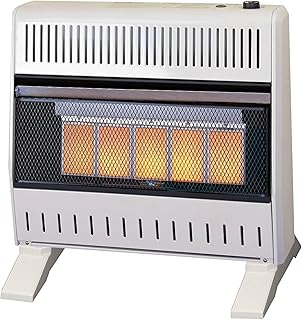
The ProCom model delivers 30,000 BTU with infrared heating and no electricity required. It can heat up to 1,200 square feet and uses a piezo push-button ignition. It’s manual control with three heat settings—Low, Medium, High—plus an Oxygen Depletion Sensor with automatic shut-off. This option is ideal for homes seeking a reliable gas-only heater without electrical dependence, particularly in areas with frequent outages. Caution: ensure proper venting and clearance as with any ventless infrared unit.
30,000 BTU Dual Fuel Wall Heater (Natural Gas or Propane)

This dual-fuel heater supports both propane and natural gas, offering flexibility for homes with different gas sources. It uses infrared technology for efficient warmth across up to 1,000 square feet and includes an electronic spark ignition along with thermostatic control. An Oxygen Depletion Sensor and auto shut-off contribute to safety. Best for buyers who want to switch fuel types or already have a mixed-fuel setup. Choose this if fuel flexibility and infrared efficiency are priorities.
Comfort Glow 17,000 BTU Direct Vent Wall Heater

This direct vent heater delivers 17,000 BTU and is designed for wall mounting with a direct vent system. It features an electronic ignition, a built-in safety pilot, and a pressure regulator to stop gas flow if the pilot extinguishes. It’s best for smaller spaces where a compact, vented solution is preferred. While vented units typically require venting to the outdoors, they can offer stable operation in well-ventilated rooms. Consider this if space is limited and you need a quieter, sealed combustion option.
Buying Guide: Key Considerations For Wall Mounted Gas Heaters
- Heat output and room size: Match BTUs to the space. Most 30,000 BTU models heat up to around 1,000–1,200 sq ft, while smaller units fit 400–600 sq ft.
- Ventilation: Vent-free vs direct vent affects indoor air quality and installation. Vent-free units are easier to install but require caution in sealed homes; direct vent models exhaust outdoors.
- Fuel type and electricity: Dual-fuel models offer flexibility; electric heaters provide an alternative when gas is unavailable. Gas-only models need proper gas lines and clearance.
- Ignition and controls: Battery or piezo ignition saves battery use; thermostat control improves consistency. Manual settings provide straightforward operation.
- Safety features: Oxygen Depletion Sensor (ODS), auto shut-off, and built-in regulators are important for safe operation in occupied spaces.
- Installation considerations: Clearances to walls, ceilings, and furnishings, plus mounting height, impact performance and safety. Check local codes for venting and exhaust requirements.
- Maintenance: Regular inspection of gas lines, igniters, and sensors helps maintain efficiency and safety. Vent-free units may require air-quality monitoring.
Frequently Asked Questions
- What size room suits a 30,000 BTU wall heater? Answer: Typically 1,000–1,200 sq ft, depending on insulation and climate.
- Is vent-free heating safe for extended use? Answer: Vent-free units are designed for indoor use but require proper installation, ventilation balance, and carbon monoxide considerations as with any gas heater.
- Do dual-fuel heaters save money? Answer: They offer flexibility depending on fuel prices and availability, which can help optimize operating costs.
- Can I install a wall heater myself? Answer: Some models are designed for do-it-yourself installation with clearances; others require professional installation due to venting and gas line work. Always consult local codes.
- Which heater is best for a small room? Answer: A compact 17,000 BTU vented model or a small 30,000 BTU unit with efficient direct venting can be suitable, depending on insulation and ceiling height.
- What maintenance is essential? Answer: Regularly inspect ignition systems, sensors, and seals; ensure proper venting; and check for gas leaks and proper airflow.