Answering the need for immediate protection, these automatic shut-off water heater systems stop leaks and prevent floods. They’re best suited for homeowners, landlords, and small business properties seeking rapid, automated responses to water leaks around water heaters, laundry rooms, and utility areas. Below is a concise buyer’s guide and five top picks with clear, objective comparisons to help you choose the right solution for your space.
| Product | Best For | Best Feature |
|---|---|---|
| FloodStop Leak Detectors (3/4″ NPT) | Residential & small commercial | Automatic shut-off with audible/visual alarms |
| E-SDS Leak Detector Systems | Homeowners who want simple installs | Manual override plus automatic shutoff |
| Zuomeng WiFi Leak Detector Kit | Remote monitoring fans | Smart app control and remote shutoff |
| YoLink DIY Starter Kit | Smart-home enthusiasts | Device-to-device control without power |
| Aquanta Smart Water Heater Timer | On-demand hot water management | Alexa-compatible scheduling |
FloodStop Leak Detector Kit with Automatic Shut-Off (3/4″ NPT)

The FloodStop 3/4″ NPT kit offers automatic shut-off and audible/visual alarms. It responds to water on the sensor by closing the valve and sounding an alarm, then keeps the valve closed until water loss is detected. Best for: homes needing rapid isolation of a leaking water heater with clear alerts. Caution: ensure compatible piping fittings before installation.
FloodStop NEW Water Heater Leak Detector Kit (3/4″ NPT)
This kit emphasizes ease of installation and reliable full-port brass valves. Best for: larger spaces where quick, fully featured shut-off is critical. It’s designed to keep other fixtures operational during an incident. Limitation: system sizing should match the plumbing layout to avoid compatibility issues.
FloodStop 1/2 Inch NPT Leak Detector Kit
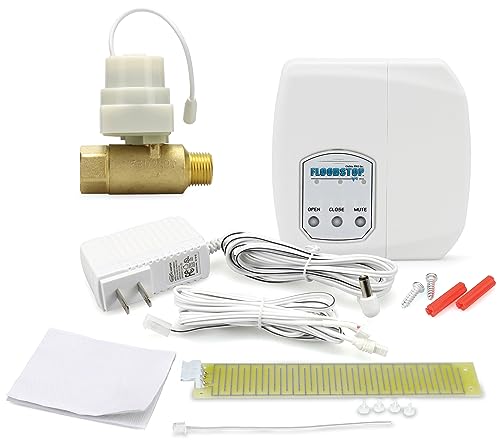
This model offers easy installation and audible/visual alarms with a heavy-duty brass valve rated up to 140 PSI. Best for: smaller residential systems or spaces where a compact 1/2″ valve is preferred. Caution: check pressure rating to ensure compatibility with local supply pressures.
FloodStop Point-of-Use Leak Detector with Alarms (3/4″ NPT)
Designed for quick installs in areas like under sinks or near water heaters, this variant focuses on point-of-use protection with audible/visual cues. Best for: quick deployment in small rooms. Limitation: coverage is localized, not a whole-house solution in one unit.
YoLink DIY Automatic Leak Detection & Shut-Off Starter Kit

This kit provides a smart, wireless solution with three leak sensors, a valve controller, an EVO valve manipulator, and a hub. Best for: homeowners seeking a networked, offline-capable system that can operate during power or network disruptions. Caution: setup requires a compatible app and initial pairing; connectivity can vary by environment.
Aquanta Smart Water Heater Timer

The Aquanta timer learns your schedule to turn hot water on and off automatically. Best for: storage-style electric water heaters where remote control and scheduling enhance efficiency. It’s Alexa-compatible and suitable for users who want smart control without frequent manual adjustments. Caution: does not replace a valve shut-off in the event of a major leak; it manages heating cycles rather than immediate shutoff.
Buying Guide
What should you consider when choosing an automatic shut-off system for a water heater?
- Valve type and size: Ensure the valve matches your pipe threads (NPT 1/2″ or 3/4″) and that it’s compatible with your heater model.
- Detection method: Leaks can trigger from various locations. Some systems sense water on a sensor, others require a flow-based shutoff; choose based on where leaks are most likely to occur in your setup.
- Alerts: Audible and visual alerts help occupants react quickly. Consider whether remote monitoring or app notifications are important for your property type.
- Power and connectivity: Some kits operate offline, while others rely on Wi-Fi or a hub. For remote properties, offline-capable devices provide extra protection during outages.
- Installation complexity: Some units are plug-and-play, while others require existing plumbing modifications. Evaluate your DIY comfort or plan professional installation.
- Compatibility: Verify compatibility with your water heater type (gas vs. electric), pipe sizes, and local plumbing codes.
Frequently Asked Questions
- Do these systems shut off water automatically during a leak?
- Can I monitor leaks remotely?
- Are these units hard to install?
- Will a shut-off system protect all areas of my home?
- What maintenance is required?
- Do these systems work during power outages?
Yes. Most products automatically shut off the water supply when a leak is detected, reducing flood risk and damage.
Some systems include mobile apps or hubs for remote alerts. Others function locally with audible alarms; check product features for connectivity.
Install difficulty varies. Some kits are quick-install point-of-use solutions; others require plumbing connections and basic electrical steps.
Many kits focus on water heaters and nearby fixtures. Comprehensive protection may require combining a shut-off valve with sensors in other high-risk zones.
Most systems are maintenance-free beyond periodic testing. Some models offer battery backups or alarm tests—refer to each product’s guidance.
Offline or device-to-device kits can operate during power or network outages, depending on design. Verify power independence if you expect outages.