Finding the right water heater for a boat means balancing capacity, footprint, and electrical needs with the realities of marine installation. This guide highlights five sturdy 120V options that deliver steady hot water for galley use, showers, and washups while cruising. Each pick targets a different boat setup—compact spaces, front or side mounting, and varying hot-water demands—so you can choose with confidence. The following table summarizes key details to compare at a glance.
| Product | Capacity | Mounting Type | Best For |
|---|---|---|---|
| Kuuma Marine Water Heater (Front Mount) | 6 gallons | Front mount | Smaller boats needing compact, accessible installation |
| Kuuma Marine Water Heater (Side Mount) | 6 gallons | Side mount | Galley-first layouts with horizontal space |
| Whale Premium Water Heater (3 or 6 gal) | 3 or 6 gallons | Standard 120V install | Budget-friendly, moderate hot-water needs |
| Whale Premium Water Heater (11 gal) | 11 gallons | Standard 120V install | Higher hot-water demand, larger boats or liveaboard use |
| Whale Premium Water Heater (3 or 6 gal) | 3 or 6 gallons | Standard 120V install | Compact spaces needing flexible capacity |
Kuuma Front-Mount 6 Gallon Water Heater

This Kuuma front-mount model provides a compact 6-gallon supply ideal for boats with tight engine rooms or galley spaces. It uses a 120V, 1500W input to heat water efficiently, suitable for daily showers and kitchen use. Best for boats where a front-access unit is the simplest installation. A potential limitation is the vertical clearance required above the unit in some installations, so measure carefully.
Kuuma Side-Mount 6 Gallon Water Heater

This 6-gallon Kuuma unit with a side-mount configuration fits boats where lateral space is more available than vertical room. Like the front-mount, it operates on 120V at 1500W, delivering steady hot water for galley tasks and showers. Choose this if your installation favors side clearance, or if your cockpit or aft cabin layout makes a side-tilt approach more practical. A caution is to verify the side access panel clearance in crowded engine rooms.
Whale Premium Water Heater, 6-Gallon
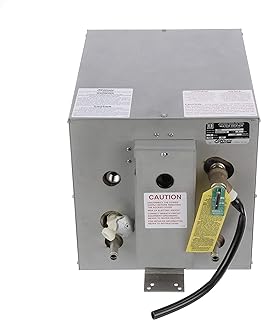
Whale’s 6-gallon model is designed for reliability and simple installation. It maintains a robust hot-water supply with durable construction, making it a solid choice for boats and RVs that need a straightforward 120V heater. Best for moderate hot-water needs with an emphasis on long service life. Limitation: the 6-gallon size may require careful planning for very high daily use or larger crews.
Whale Premium Water Heater, 11 Gallon

The 11-gallon Whale model covers higher hot-water demand with a larger reservoir, suitable for longer showers or shared galley use aboard bigger boats. It uses standard 120V input and is built to endure marine conditions, offering long service life. Best for liveaboard or larger-cabin boats. A potential drawback is higher upfront space requirements and weight compared to smaller units.
Whale Premium Water Heater, 6-Gallon (Another 3/6 Gal Option)

This 3- or 6-gallon Whale unit provides a flexible option for boats with varied hot-water needs. The 6-gallon choice suits moderate demand, while the 3-gallon setting is handy when space is at a premium. Best for smaller crews or limited galley usage where heat-up speed is less critical. Limitation: the smaller capacity may require more frequent reheating on busy days.
Buying Guide: Practical Considerations For Marine Water Heaters
What capacity do you actually need? For single- or couple-boat use, 6 gallons is often sufficient for a couple of showers and daily washups. Larger boats or liveaboard setups may benefit from 11 gallons to reduce heat cycles and ensure a steady supply. Consider peak usage patterns and whether you prioritize fast recovery or long hold times.
Which mounting style fits your space? Front-mount units are quick to service and good for tight engine rooms, while side-mount models suit wider, lower-profile installations. Measure clearance around the unit, including doors, panels, and any obstructions that could hinder removal for service.
What electrical demands are acceptable? All listed models use 120V at about 1500W. Verify your boat’s electrical capacity, shore power availability, and circuit protection to avoid tripping breakers during simultaneous loads like heating and cooking or air conditioning.
Durability and corrosion resistance matter at sea. Marine heaters should feature corrosion-resistant tanks and protective shields around controls. Consider models with solid-internal insulation and high-quality sealants to minimize heat loss and prolong life in humid environments.
Ease of installation and replacement. If you are upgrading, select a model with a similar footprint or mounting pattern to simplify installation. Some boats benefit from a “plug-and-play” approach with minimal ductwork or plumbing changes.
Frequently Asked Questions
- What size water heater is best for a small boat? A 6-gallon unit is commonly sufficient for small boats, providing a good balance of heat recovery and space use.
- Can I install a 120V water heater on a boat without shore power? Yes, but you will need a reliable power source and appropriate circuit protection for safe operation.
- Is a larger capacity worth it for a liveaboard boat? Yes, an 11-gallon model can reduce heat cycles and better support frequent hot-water use.
- What mounting type should I choose? Pick front-mount for easy access and compact spaces, or side-mount if horizontal space is plentiful.
- How do I prevent corrosion-related failures? Look for models with corrosion-resistant tanks and sealed electrical components designed for marine environments.
- Are there safety considerations during operation? Ensure proper ventilation around the heater, use appropriate fusing, and follow manufacturer installation instructions to avoid electrical or scald hazards.