Answering the most common buyer need: for campers and RV travelers, the right water heater delivers instant hot water, conserves propane, and fits standard RV openings. The top picks below are best for off-grid living, weekend trips, or full-time RV use. Each section explains who it’s best for and why it stands out, with practical limits noted. The list includes models with high altitude performance, dual outlets, and energy-saving features to suit different camping styles and plumbing setups.
Summary table of chosen products
- Somokg Store RV Tankless Water Heater — Best for high-altitude use and rapid heat
- Orbek Store ORBEK RV Tankless Water Heater — Best for efficiency with remote control
- VEVOR RV Tankless Water Heater — Best for year-round reliability and LED control
- FOGATTI HybridShower — Best for hybrid fuel options and fast recovery
- Xenjum Store RV Tankless Water Heater — Best for dual outlets and precise control
Somokg Store RV Tankless Water Heater

Key features include instant heat up to 3.9 GPM with precise ±1°F temperature control. It uses a 1.5 kg heavy-duty copper heat exchanger and 30% thicker elbows for durability in harsh conditions, and widened gas nozzles to support altitudes up to 9840 ft. The smart ignition automatically fires with faucet use and adjusts seasonally to prevent overheating. Best for: campers who frequently face cold weather, high altitude driving, or off-grid showers. Limitation: performance depends on water pressure and propane supply at the campsite.
Orbek RV Tankless Water Heater

Highlights include continuous on-demand hot water powered by a 60,000 BTU propane burner, with a design that ignites only when hot water is requested. Optional RV door panels help with appearance and fit, and the unit uses oxygen-free copper heat exchangers and brushless DC fans to support high-altitude operation with steady temperatures. Best for: RV families and travelers who want reliable hot water without keeping a tank heated. Limitation: ensure your cutout size matches standard 15″ × 15″ or 15″ × 18″ openings before purchase.
VEVOR RV Tankless Water Heater

Features 42,000 BTU of power for rapid heating and an LED smart display with touch controls. It uses segmented combustion to adjust water temperature seasonally for year-round comfort and energy efficiency. Best for: RVers who want straightforward, all-season operation with easy temperature control. Limitation: higher power models require appropriate propane supply and venting considerations in some rigs.
FOGATTI HybridShower 10 Ultra RV Tank Water Heater

Hybrid gas-electric operation combines a 12,000 BTU propane burner with electric mode to deliver up to 20% more heating power than standard 10,000 BTU units. Trip power flexibility supports propane, electric, or hybrid modes, and built-in titanium anode design minimizes maintenance. Best for: campers who value maximum heating power and flexibility in power sources. Limitation: the hybrid mode may require more complex installation for some RVs and needs a compatible electrical system.
Xenjum Store RV Tankless Water Heater
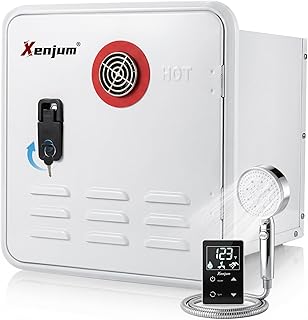
This model delivers up to 65,000 BTU and 3.9 GPM with dual outlets for interior and exterior hot water distribution. Temperature is adjustable from 95–123°F via remote control, and a built-in thermostat maintains ±1°F precision. Best for: RVs needing hot water throughout multiple outlets, including exterior use for pets or outdoor cleanup. Limitation: ensure your RV’s electrical and propane setup can support dual outlets and the remote system.
Buying Guide: Key Considerations For Picking A Camper Water Heater
- Fuel source and efficiency: Do you rely on propane, electric power, or a hybrid system? Consider how you boondock and your access to shore power.
- Flow rate and heat capacity: Look for GPM and BTU ratings that match your shower or sink needs. Higher values support simultaneous uses but require more energy.
- Altitude performance: If you travel to high elevations, prioritize models with enhanced ignition and copper heat exchangers designed for altitudes.
- Openings and installation: Check the standard RV cutout sizes (such as 15″ × 15″ or 15″ × 18″) and ensure the unit fits your current opening without modification.
- Temperature control: Precision thermostats and remote control options help maintain comfortable water temperatures with minimal fluctuations.
- Outlets and distribution: Dual outlets can supply hot water to multiple fixtures; confirm placement and compatibility with your plumbing layout.
- Durability and maintenance: Look for anti-freeze capability, robust heat exchangers, and design features that minimize maintenance needs in harsh camping environments.
- Safety and certification: CSA or other local certifications add confidence in safe operation on the road.
Quick FAQs
- How much hot water can a camper tankless heater provide? — Most units deliver 3.9 GPM to 3.9 GPM or similar flow rates, depending on water temperature and heater capacity.
- Do these units work off-grid? — Yes, many models are designed for off-grid use, with propane and/or 12V/shore power compatibility.
- Can I install a tankless heater in an older RV? — Installation depends on cutout size, venting, and propane lines; refer to the product’s mounting guidelines and your RV’s layout.
- Is remote temperature control necessary? — Remote controls offer convenient adjustment, especially when water is used in outdoor areas or at distant fixtures.
- What should I consider for high-altitude camping? — Choose models with high-altitude ignition, efficient fuel use, and copper heat exchangers designed for thinner air.
- Do these units require professional installation? — Some installations are DIY-friendly if you have basic plumbing and gas line work experience, but professional installation is recommended for safety and compliance.