Answering the most common buyer question: which scale-removal tools are best for keeping water heaters efficient and free of mineral build-up? This guide highlights five reliable products and explains who each is best for. It targets homeowners, DIY enthusiasts, and property managers seeking easier, practical maintenance solutions. Below is a concise comparison and a quick buying guide to help you pick the right option for your system.
| Product | Best For | Why It Stands Out |
|---|---|---|
| ScaleRX ¾-Inch Water Heater Descaler and Scale Prevention System | Preventive maintenance for home water heaters | Combo of descaling and prevention to reduce lime scale buildup |
| Sediment Gone™ Water Heater Sediment Removal Tool | DIY flushes for stubborn sediment in tanks | Active agitation during draining improves sediment removal |
| Sediment Buster UL Verified V699054 | Safer, validated flushing under heat and pressure | UL verification signals reliable operation in high-temp/pressure |
| QwikDescaler + Descaler Solution | Tankless and traditional heaters needing quick, visible descaling | Visual cue (red to yellow) shows when more solution is needed |
| Waterdrop AP431 AP430SS Whole House Scale Inhibitor | Whole-house protection and high-flow filtration | Food-grade inhibitors with high flow and broad protection |
ScaleRX ¾-Inch Descaler and Scale Prevention System

Best for: Homeowners seeking a practical prevention device. Why selected: It combines descaling and scale prevention, aimed at reducing lime-scale buildup in standard water heaters. The system is straightforward to install and designed to lower future maintenance needs. Caution: Effectiveness depends on regular flushing intervals and compatibility with your heater’s inlet/outlet sizing.
Sediment Gone™ Water Heater Sediment Removal Tool

Best for: DIY homeowners dealing with heavy sediment buildup. Why selected: The tool is designed to stir, loosen, and flush out stubborn sediment, actively breaking up compacted deposits during draining. It connects to standard garden hoses for controlled draining. Caution: Success depends on proper threading to the drain valve and adherence to manufacturer instructions.
Sediment Buster UL Verified V699054

Best for: Users prioritizing safety and reliability during flushes. Why selected: UL verification indicates safety under heat and pressure, with straightforward instructions. It helps extend the life of a water heater through regular maintenance. Caution: Users should follow safety guidelines to avoid scalding or pressurized water hazards during operation.
QwikDescaler + Concentrated Descaler Solution
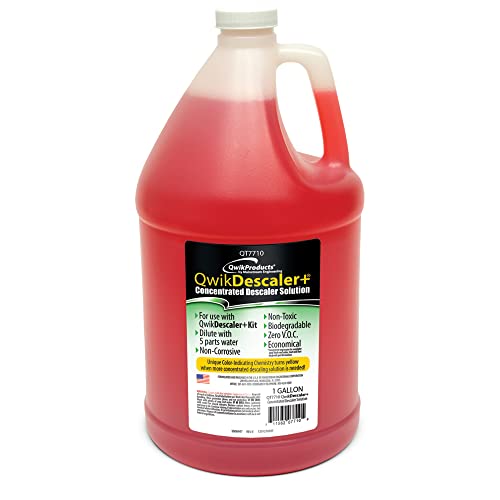
Best for: Tankless heaters and quick refurbishment of mineral deposits. Why selected: It rapidly dissolves scale, lime, and tarnish, and provides a clear visual cue when more solution is required. Caution: Not a substitute for all forms of tank maintenance; use as part of a regular maintenance routine.
Waterdrop AP431 AP430SS Whole House Scale Inhibitor

Best for: Homes needing broad-scale protection across multiple appliances. Why selected: It uses food-grade polyphosphates to inhibit scale formation, improving efficiency and protecting heaters, boilers, and downstream fixtures. Caution: It provides prevention more than immediate descaling, so existing heavy deposits may require a flush first.
Buying Guide: Key Purchase Considerations
- Scale type and system compatibility: Determine whether your concern is mineral scale buildup, sediment deposits, or both. Some tools target general scale inhibition, while others focus on repetitive flushing of sediment.
- Installation and maintenance effort: Some products are quick installs with periodic flushing, while others require ongoing monitoring and repeated cycles to stay effective.
- System type: Tank vs. tankless heaters may respond differently to descalers or flush tools. Tankless units often benefit from rapid descaling solutions with clear usage cues.
- Quality and safety assurances: UL verification or BPA-free materials are important signals of safe operation and long-term durability.
- Environmental and health considerations: Look for low-VOC or non-toxic formulations when selecting descalers, particularly for homes with sensitive occupants.
- Cost vs. benefit: Consider the expected maintenance interval, lifespan of the tool, and potential savings from improved heater efficiency and extended equipment life.
Frequently Asked Questions
- What is the main difference between a descaler and a sediment removal tool?
Descalers target mineral scale deposits on heating elements, while sediment tools physically disturb and flush out settled particles at the bottom of the tank.
- Can these tools be used on all water heaters?
Most tools are designed for standard residential heaters; check inlet/outlet sizing and the drain valve type before use.
- How often should I perform a sediment flush?
Frequency depends on water hardness and usage, but annual or semi-annual flushing is common for many homes.
- Is UL verification necessary to trust a flushing tool?
UL verification adds a safety assurance for high-temperature and high-pressure conditions, but proper operation and following instructions remain essential.
- Do descalers affect appliance warranty?
Always verify warranty terms with your manufacturer; some warranties require professional service for certain maintenance tasks.
- Is a whole-house inhibitor better than point-of-use descalers?
Whole-house inhibitors provide broader protection across multiple fixtures and appliances, potentially reducing overall mineral buildup.