Answering the question for buyers seeking a clean, space-saving heat source, these in-wall heating units offer compact design, steady warmth, and safety-conscious features. Ideal for small rooms, bathrooms, bedrooms, or areas without ducted heat, these options emphasize energy efficiency and controllability. This guide highlights five reliable picks and explains who each is best for, with practical buying tips and quick comparisons.
| Product | Best For | Key Feature |
|---|---|---|
| INFANDY 240V Wall Heater | Families needing multiple modes | Three modes and 9H timer |
| Onylraep CSC151TW | Quiet, low-noise heating | 5120 BTU/h, silent operation |
| ENVI Plug-in Panel | Low-watt, safe 24/7 use | Fan-less stack convection |
| JNDRO Wall Heater | Oscillating coverage | 60°/90°/120° oscillation |
| DREO Smart Wall Heater | Smart home compatibility | Alexa/Google, 120° oscillation |
INFANDY Store 240V Electric Wall Heater

The INFANDY 240V wall heater offers three modes: Full Power, Eco, and Ventilation. It includes a remote, a 9H timer, and a child lock, with overheat protection for safe indoors use. Best for households that want flexible control with energy savings in mind. Choose this if you need rapid heating with the option to circulate air without heat.
Best for: families and small apartments needing adjustable warmth and safety features. The built-in thermostat supports 40°F–86°F and supports Fahrenheit/Celsius switching for simple operation. A potential limitation is the need for hardwired installation, not a plug-in unit.
Data snapshot:
- Power: 1500W / 750W modes
- Control: Remote, timer, child lock
- Safety: Overheat protection
Onylraep CSC151TW Electric Wall Heater

This unit delivers 5120 BTU/h via 1500W at 120V, designed for efficient room heating with quiet operation. It features automatic overheat protection and a sturdy white housing. Best for: rooms where quiet, steady warmth is important, such as bedrooms or offices. Caution: higher wattage requires appropriate electrical circuit and professional installation.
Why it stands out: even heat distribution with solid construction and an emphasis on energy usage reduction. It’s a practical choice when you want reliable warmth without disruptive noise.
Data snapshot:
- Heat output: 5120 BTU/h
- Coverage: Even heat distribution
- Safety: Overheat protection
ENVI Plug-in Panel Wall Heaters

The ENVI wall heater emphasizes energy efficiency with a low-wattage design and a fan-less, stack-convection approach. It runs safely at around 90°F and includes a wall-sense safety feature. Best for: homes with children, the elderly, or pets needing a continuous, low-noise heating solution. Limitation: plug-in design may be less suitable for permanent installations in some spaces.
Why to consider this: its quiet operation and 24/7 capability make it a strong choice for ongoing room comfort and better indoor air quality by avoiding noisy fans.
Data snapshot:
- Design: Fan-less, stack convection
- Safety: Wall-sense sensor
- Usage: 24/7 operation possible
JNDRO Wall-Mounted Space Heater

The JNDRO heater features ECO energy-saving mode and an LED display with remote control. It offers 60°, 90°, and 120° oscillation, plus a 24-hour timer. Best for: larger living spaces needing wide heat distribution and convenient remote management. Better for: users who want flexible heat angles to optimize room coverage. Limitation: oscillation may require careful placement to avoid drafts in small spaces.
Why it’s chosen: high coverage angle helps evenly heat multi-use rooms and the ECO mode contributes to energy savings over time.
Data snapshot:
- Heat control: ECO mode, 41–95°F
- Oscillation: 60°/90°/120°
- Remotely adjustable: yes
DREO Smart Wall Heater
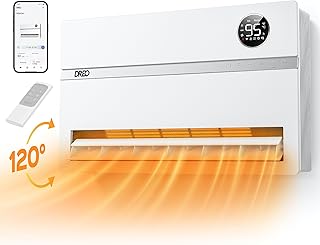
The DREO model emphasizes smart control with Alexa and Google Home compatibility, 120° oscillation, ECO mode, an adjustable thermostat, and a 24-hour timer. It’s best for: tech-enabled homes that want voice and app-driven climate control. A note: ensure compatibility with your smart ecosystem and Wi-Fi setup to maximize benefits.
Why it’s recommended: broad heat distribution and hands-free control offer convenient operation for busy households or smart-home enthusiasts.
Buying Guide: In-Wall Heating Units
What room size should you target? Measure the space and pick a unit with sufficient BTU output for reliable warmth. For smaller rooms, a lower wattage unit with efficient heat distribution often performs best.
What installation considerations matter? Some units require hardwiring, while others are plug-in designs. Check electrical capacity and local codes. A professional installation is advisable for high-wattage or bathroom installations.
Which features improve safety and comfort? Look for overheat protection, child locks, and low-noise operation. A thermostat with a wide set-point range helps tailor comfort through seasons. If allergies are a concern, pick fan-less designs to reduce dust movement.
How important is smart control? If you value remote access, voice control, or scheduling, prioritize models with compatible apps or assistants. Verify compatibility before purchase.
Which design suits your decor? In-wall heaters blend with most interiors, so select a model with a finish that matches your wall color and trim. Consider whether you want a visible thermostat control or a seamless wall unit.
FAQ
Do in-wall heaters require professional installation?
Many models require hardwiring and proper electrical circuit capacity; professional installation is recommended for safety and code compliance.
Are fan-assisted heaters louder than fan-less models?
Yes. Fan-less designs tend to be quieter, suitable for bedrooms and study areas.
Can these heaters operate in bathrooms?
Some models are designed for bathrooms or damp environments, but verify bathroom suitability and electrical ratings before use.
Do smart features add significant energy savings?
Smart controls can optimize usage by scheduling, remote adjustments, and adaptive temperature settings, aiding efficiency.
What maintenance is required?
Keep vents clear, clean exterior surfaces, and check for any signs of wear. Always follow the manufacturer’s maintenance guidelines.